About Diadema antillarum (Philippi, 1845)
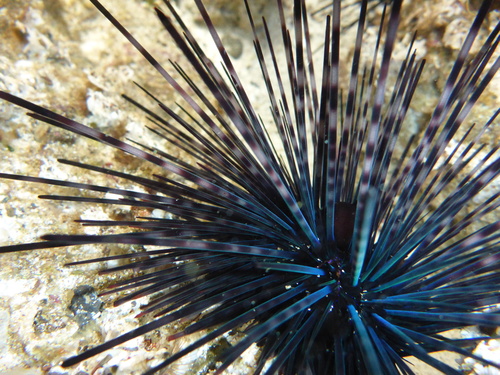
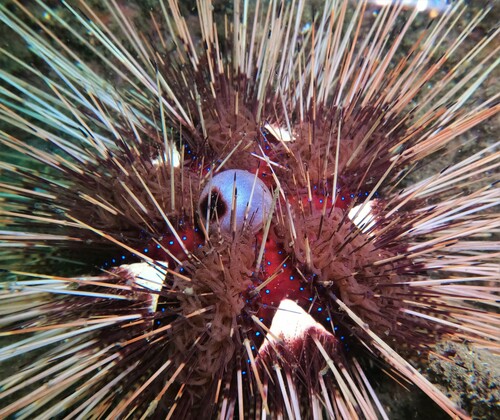
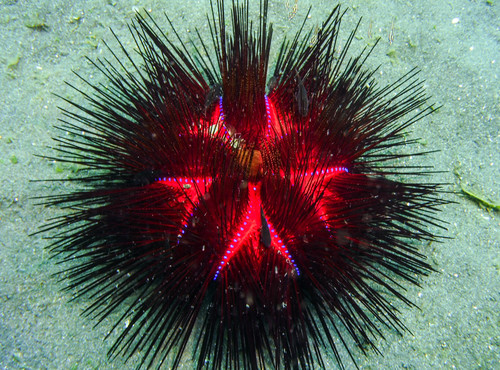
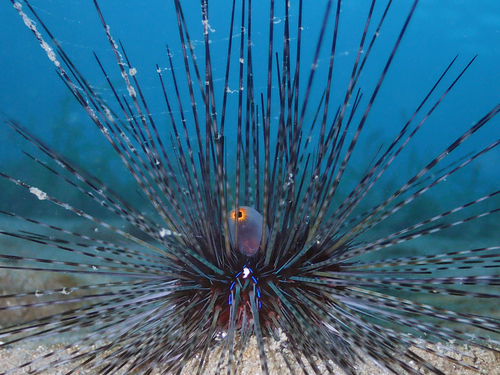
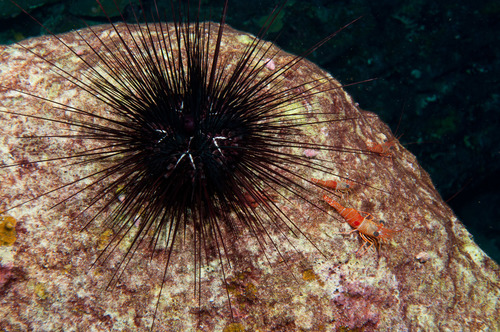
Diadema antillarum (Philippi, 1845), commonly called the lime urchin, black sea urchin, or long-spined sea urchin, is a species of sea urchin that belongs to the family Diadematidae. This species is defined by its exceptionally long black spines. It is the most abundant and ecologically important herbivore on coral reefs located in the western Atlantic and Caribbean basin. When Diadema antillarum populations are at healthy levels, the urchins act as main grazers that stop algae from overgrowing reefs.
In some tropical regions, Diadema antillarum remains one of the most abundant, widespread, and ecologically important shallow-water sea urchin species. Its range covers the tropical Western Atlantic Ocean, including the Caribbean Sea, the Gulf of Mexico, and the northern and eastern coasts of South America, extending south as far as Brazil. It is also found in the East Atlantic at the Canary Islands and in the Indian Ocean.
In 1983, a mass mortality event killed more than 97% of Diadema antillarum across the entire Caribbean faunal zone, from the Bahamas in the north to South America in the south. After this event, many Caribbean reefs became overgrown with foliose macroalgae. This overgrowth blocks coral growth and has worsened the ongoing decline of scleractinian corals. It also has a general negative impact on coral reef resilience, the ability of a reef system to resist and recover from changes caused by disturbance events.
Recent studies conducted at Discovery Bay, Jamaica, and other locations indicate that Diadema antillarum has made a substantial comeback, alongside major regeneration of local reefs. As of 2015, the densest populations occur in the eastern Caribbean at Jamaica, Barbados, Dominica, and Puerto Rico. Populations either stay virtually stable at low levels or show small increases along the coast of Central America, and in Cuba, Florida, the Bahamas, the Virgin Islands, and Curaçao. The fastest rate of population increase has been recorded on the north coast of Jamaica, while the slowest rates are seen in Florida, Cuba, and the Bahamas. Two separate populations, one in Venezuela and one in Panama's San Blas Islands, have actually continued to decline over time. In 2022, another die-off of Diadema antillarum was reported in the Caribbean, specifically affecting the U.S. Virgin Islands, Saba, and St. Eustatius.