About Diabrotica balteata J.L.LeConte, 1865
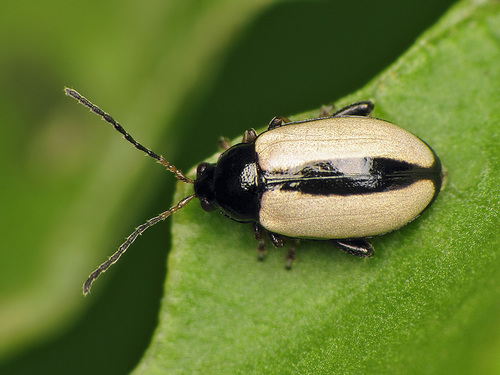
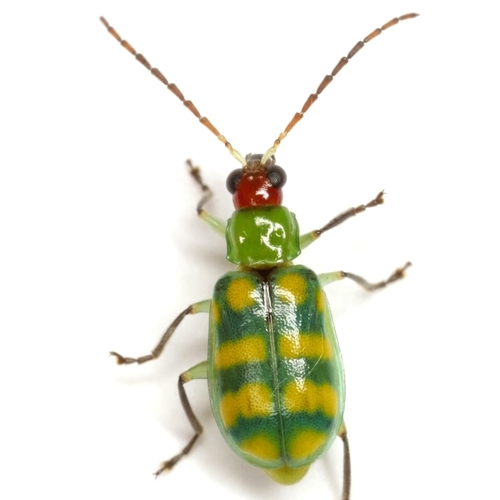
Description and life cycle: This Diabrotica balteata beetle measures 5 to 6 millimeters long. It has a red head, a black thorax, and yellow elytra. The elytra are marked with three transverse bands in shades of green or blue-green, plus a narrower longitudinal green line running down the center. Banding patterns are variable, and are nearly absent in some individuals. Elytra color is influenced by the types of plants the beetle eats. Larvae of this species are also variable, and go through three instar stages. Newly hatched larvae are white, around 2.3 millimeters long, and may turn yellow as they consume plant material. Late-instar larvae can grow to nearly 9 millimeters in length. Adults reach mating maturity at approximately six days old. Around 16 days after mating, females begin producing eggs. Females lay a cluster of eggs every few days over a period of two to eight weeks, producing up to 15 clusters and a maximum total of 850 eggs. Each cluster holds up to 100 oval yellow eggs, each about half a millimeter long. Females oviposit egg clusters in soil cracks, and eggs hatch 5 to 9 days after being laid. Larval development takes 11 to 17 days, followed by a pupal stage that lasts 4 to 6 days. The average lifespan of an adult is 26 days. This species does not enter diapause, and under optimal conditions can produce six or seven generations per year. In Tamaulipas, Mexico, this beetle is most commonly observed between May and July, which may be a period of high dispersal. Population abundance appears to increase after late spring and summer rainfall, and flight activity increases with higher wind speed. Distribution: This beetle likely originated in tropical America, and has since spread into more temperate climates. By the early 1900s, it was only found in Arizona and Texas in the United States. During the 1920s, it spread up the coast of California at a rate of approximately 25 miles per year. It has since spread as far east as North Carolina and as far south as Florida. It will probably not spread further into the continental United States, as it cannot tolerate freezing temperatures. Ecology: Natural enemies of this beetle include ants, which prey on its eggs, particularly in tropical regions. A species of Heterorhabditis nematode isolated from this beetle's larvae has been confirmed to be a parasite that causes rapid mortality in the beetle. This species is also a host for the tachinid fly parasitoid Celatoria compressa.