About Desmognathus welteri Barbour, 1950
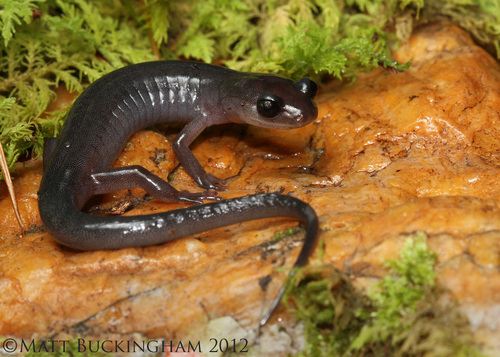
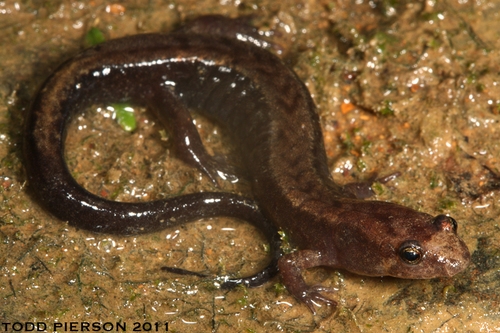
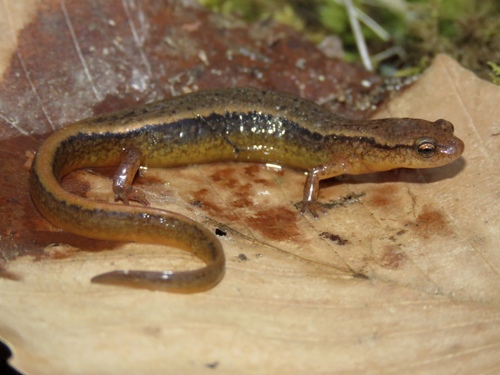
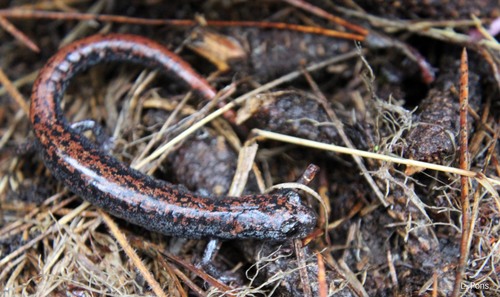
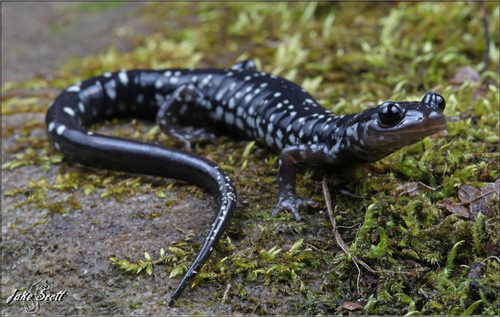
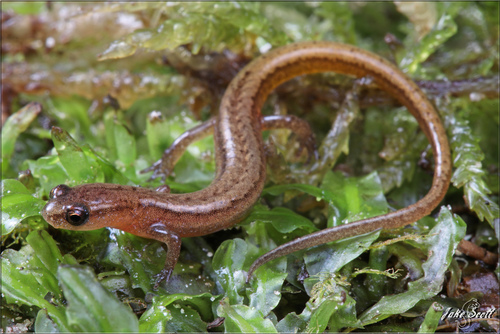
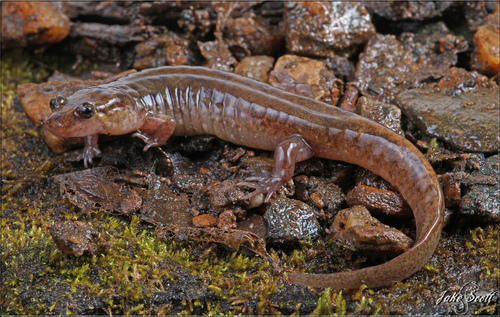
The black mountain salamander (Desmognathus welteri Barbour, 1950) is a robust dusky salamander that looks similar to many other species in its genus found in its upland habitat. Adults grow to around 12 cm (5 in) in length, with short, stout limbs. Their body color is variable, but upper surfaces are usually pale to medium brown, with an indistinct pattern of lighter markings. The underside is whitish, marked with dark spots and blotches. This species is endemic to the southern Appalachian Mountains in the southeastern United States. Its total range covers approximately 20,000 square kilometres (4,900,000 acres), spanning eastern Kentucky, southwestern Virginia, and eastern Tennessee. It occurs at elevations between 300 and 1,220 metres (980 to 4,000 ft) above sea level. Its natural habitats include temperate forests, rivers, freshwater marshes, and springs; it can typically be found in wooded mountain terrain, where it hides under rocks and logs in swift-flowing streams, pools, and wet ditches. It shares its range with the more terrestrial seal salamander (Desmognathus monticola) and northern dusky salamander (Desmognathus fuscus), as well as the aquatic blackbelly salamander (Desmognathus quadramaculatus), which shares its aquatic habits. Courtship behaviour of the black mountain salamander has not been documented. Reproduction occurs in spring or summer. Females lay egg clusters in or just next to small fast-flowing streams, in moist crevices, or among wet leaves in the splash zone. Around 25 eggs, connected by short stalks in a grape-like cluster, are produced per clutch. The eggs have large yolks, and larvae develop for a period inside the egg. The female guards and broods the eggs until hatching. Larvae are aquatic, and usually live in quiet shallow sections of streams. The larval stage lasts 20 to 24 months. After metamorphosis, juveniles tend to occupy deeper water than adults, or spend more time on land. This behaviour may reduce competition or avoid predation from cannibalistic blackbelly salamanders. Black mountain salamanders are thought to reach sexual maturity at 4 to 5 years old, when they reach a snout-to-vent length of approximately 5 centimetres (2.0 in). Individuals have been recorded living up to 20 years in captivity.