About Desmognathus fuscus (Rafinesque, 1820)
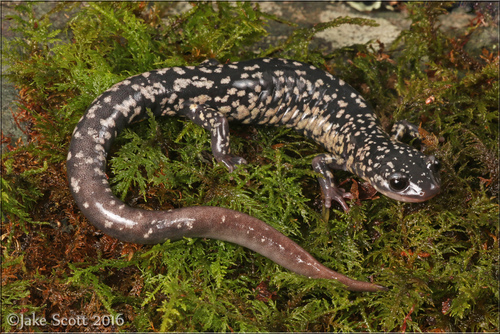
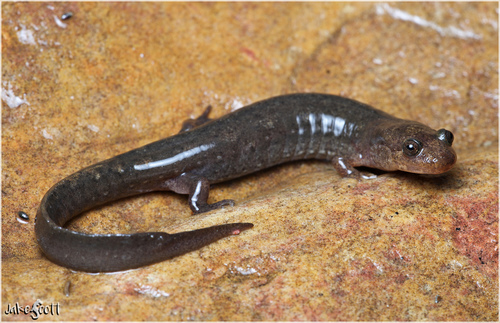
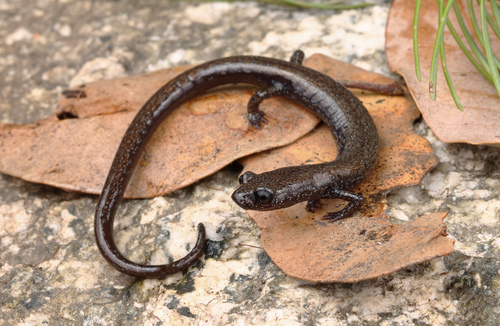
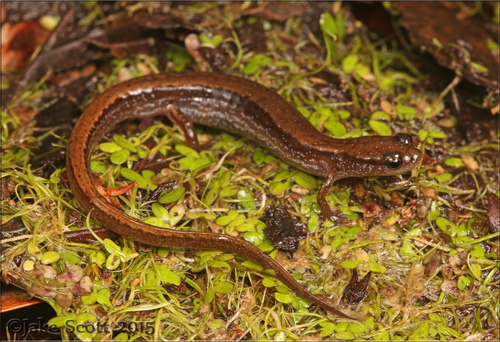
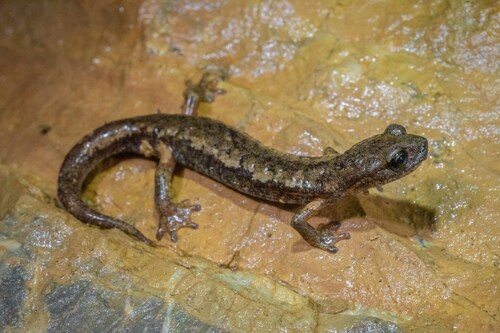
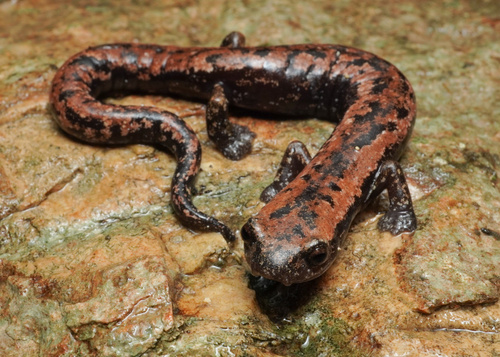
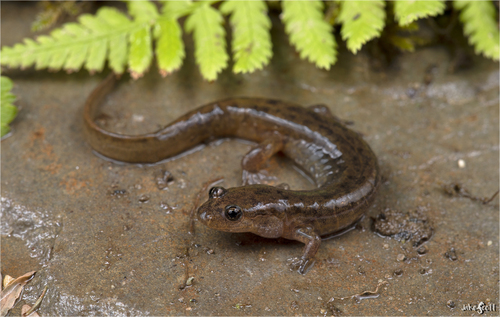
Desmognathus fuscus, commonly called the northern dusky salamander, is a small but sturdy lungless salamander in the family Plethodontidae. Its upper body ranges in color from reddish-brown to gray or olive, with a white or grey underside. The body is sparsely covered in dark spots or mottling that is most concentrated on the sides. It may have a light dorsal stripe or two dark stripes that continue onto the proximal part of the tail. Juveniles have five to eight pairs of dorsal spots or blotches between their front and hind legs, while older individuals tend to be uniformly dark brown or black. Like all dusky salamander species, both juveniles and adults have a single pale black-outlined stripe that extends from the eye diagonally to the back of the jaw. Both juveniles and adults also have 14 costal grooves, larger hind limbs than forelimbs, and a keeled knife-like tail that is triangular in cross-section and laterally compressed at its base. The tail is shorter than half the salamander’s total body length and is typically lighter in color than the body. Adults can grow up to 14 cm in total length; the average adult length is 9.4 cm for males and 8.6 cm for females. As a plethodontid salamander, this species is lungless and absorbs oxygen through its skin, plus membranous tissue in the mouth and throat. It also has a naso-labial groove that improves its sense of smell, helping it locate mates and prey by scent. This species is native to North America, found across central-eastern Canada and the United States, ranging from southern New Brunswick, southeastern Quebec and southern Ontario south to South Carolina. Populations found further south than this range are now considered to belong to other species that were previously synonymized with D. fuscus, such as D. conanti. Approximately 5% of the species’ global range falls within Canada. Within its Canadian range, the northern dusky salamander most often occurs in forested habitat along high-elevation low-order streams. Two distinct designatable units exist for the species in Canada: the Quebec/New Brunswick unit and the Carolinian unit in Ontario. A comprehensive review of D. fuscus populations in Ohio was published in the 2013 work Amphibians of Ohio. An isolated breeding population exists in eastern Michigan, though it is unknown whether this population is natural or introduced. At the northern edge of the species’ range, the northern dusky salamander lives in saturated soil in the riparian zone near springs, seepages, and small tributaries of small headwater streams. Optimal habitat occurs in undisturbed watersheds with running or trickling water and abundant forest cover. Forest cover keeps water cool and well oxygenated, and maintains the moisture and temperature levels the salamanders need to survive. In the southern part of its range, the species can be found in upland streams, as well as floodplains, sloughs, and muddy sites. Due to their limited mobility, many populations of this species are genetically distinct. Breeding happens on land annually, in either spring or fall, and involves elaborate courtship rituals. Sexually active adult males have papillose cloacal lips and a small mental gland that becomes enlarged when reproductive. Females do not have a mental gland, and have folded cloacal lips. During mating, the male rubs his snout, cheeks, and mental gland on the female’s snout; the female typically responds by picking up the male’s spermatophore. A female’s fecundity increases with her body size. Females usually lay between 10 and 30 eggs under streamside logs, moss, or rocks where the soil is water-saturated. Clutch size varies geographically, and can be as large as 45 or as small as 8. Females stay with their eggs during the 6 to 10 week (45 to 60 day) incubation period to protect eggs from desiccation and predation. When larvae hatch, they are fully aquatic and approximately 1.5 cm long. Larvae eventually metamorphose into semi-terrestrial adults; newly metamorphosed juveniles measure 2.8 to 4.4 cm in length. This species has a biphasic life cycle: larvae remain aquatic for 7 to 16 months before transitioning to a semi-terrestrial adult stage. Northern dusky salamanders reach sexual maturity at around 3 to 4 years of age, and have a life expectancy of 10 to 15 years.