About Desmodus rotundus (E.Geoffroy, 1810)
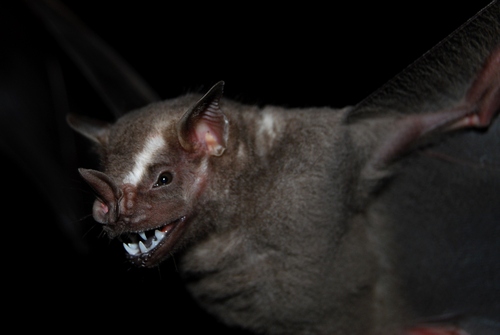
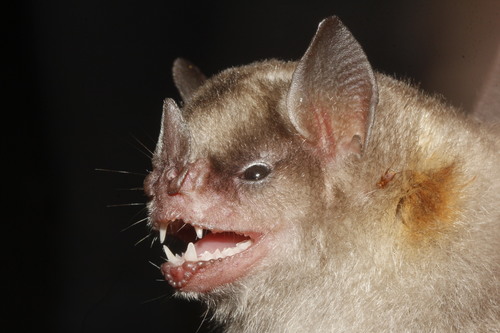
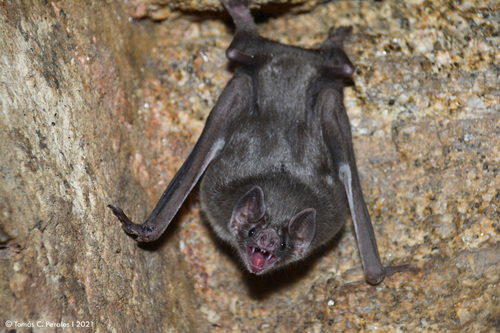
Physical description: The common vampire bat, Desmodus rotundus, has short fur, with silver-gray fur on its undersides that is clearly separated from the darker fur covering its back. It has a deeply grooved lower lip and a flat, leaf-shaped nose. Each wing has a well-developed, clawed thumb, which the bat uses to climb onto prey and assist with take-off. On average, this species is about 9 cm (3.5 in) long, with a wingspan of 18 cm (7 in). It commonly weighs between 25 and 40 grams (around 2 oz), but its weight can increase dramatically after just one feeding. Its braincase is relatively large, while the snout is reduced in size to make space for large incisors and canines. This species has the fewest teeth of any bat. The upper incisors lack enamel, which keeps them consistently razor-sharp. Its dental formula is 1.1.2.0 / 1.1.3.0, giving it a total of 18 teeth. While most other bats have almost completely lost the ability to move on land, common vampire bats are an exception. They can run using a unique bounding gait, where they use their forelimbs instead of their hindlimbs to propel themselves forward, because their wings are much more powerful than their legs. This ability likely evolved independently within the bat lineage. Three small pads under the thumb work like a sole. The common vampire bat is also capable of leaping in different directions, to different heights, and over different distances. When jumping, the bat pushes upward with its pectoral limbs. The hindlimbs keep the body positioned over the pectoral limbs, which are stabilized by the thumbs. Common vampire bats have good eyesight. They can distinguish different optical patterns, and may use vision for long-range orientation. They also have well-developed senses of smell and hearing: their cochlea is highly sensitive to low-frequency sounds, and their nasal passages are relatively large. They produce echolocation signals through their mouth, so they fly with their mouths open to navigate. They can identify a 1-centimetre (0.39 in) wide metal strip from 50 centimetres (20 in) away, a capability that is moderate compared to other bats. Range and habitat: The common vampire bat is found in parts of Mexico, Central America, and South America, as well as the Caribbean islands of Margarita and Trinidad. Its range extends as far north as 280 kilometres (170 mi) south of the Mexico–United States border. Fossils of this species have been found in Florida and U.S. states that border Mexico. The common vampire bat is the most common bat species in southeastern Brazil. The southern edge of its current range reaches Uruguay, northern Argentina, and central Chile. In the West Indies, it is only found on Trinidad. It prefers warm and humid climates, and uses tropical and subtropical woodlands and open grasslands as foraging areas. It roosts in trees, caves, abandoned buildings, old wells, and mines. Common vampire bats will share roosts with around 45 other bat species, and tend to be the most dominant species at roosting sites. They occupy the darkest and highest spots within roosts; when common vampire bats leave these spots, other bat species move in to take over the vacated areas. Mating and reproduction: Male common vampire bats guard roosting sites that attract females, but females often switch between different roosts. During estrus, a female releases one egg. Mating usually lasts between three and four minutes. The male mounts the female from the rear, grasps her back with his teeth, holds down her folded wings, and inseminates her. Common vampire bats are reproductively active year-round, though the number of conceptions and births peaks during the rainy season. Females give birth to one offspring per pregnancy, after a gestation period of around seven months. The young are primarily raised by females. Mothers leave their young to hunt, and call their young to feed when they return. Young bats accompany their mothers on hunts at six months old, but are not fully weaned until they are nine months old. Female offspring usually stay in their natal groups into adulthood, unless their mother dies or moves away. Occasional movement of unrelated females between groups leads to the formation of multiple matrilines within a single group. Male offspring generally stay in their natal groups until they are one to two years old, and are sometimes forced out by resident adult males.