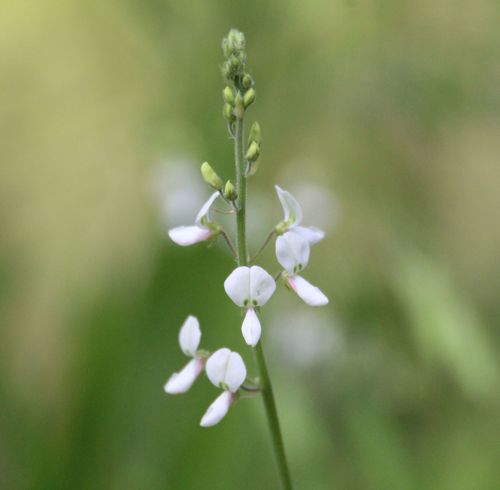
About Desmodium tweedyi Britton
The accepted scientific name of this plant is Desmodium tweedyi Britton, where Desmodium is its genus, tweedyi is its specific epithet, and Nathaniel Lord Britton is the botanist who first formally identified it. The genus name Desmodium comes from the Greek word desmos, meaning 'bond, fetter, or chain', a reference to the connected segments of the plant's legume fruit that create a chain-like appearance. The specific epithet tweedyi is a Latinized form of the last name of Frank Tweedy, a topographer and botanist. The species was named in Tweedy's honor after he collected the first recorded specimen of the plant. Frank Tweedy (1854-1937) worked as a topographer for the United States Geological Survey and was an active botanist; over 6000 of his collected plant specimens are currently held in herbaria across the United States and Canada. Most of Tweedy's collections came from his USGS work in the Rocky Mountains, with smaller collections from his work in New York's Adirondack Mountains, and from the areas where he resided in Rhode Island and New Jersey. He collected the type specimen of D. tweedyi in Texas during a visit to his brother Joseph Lord Tweedy (1849-1928). Joseph had moved from New York City to Texas in 1876, becoming one of the founding pioneers of Knickerbocker, Texas, where he owned a 20,000-acre sheep farm in Tom Green County, 278 miles southwest of Dallas. Tom Green County, the location of the first collection, sits in the center of this species' current distribution range. Nathaniel Lord Britton formally listed this species, one of 99 Texas specimens collected by Tweedy, in an 1890 journal article published by the New York Academy of Sciences. This species is primarily documented in north-central Texas, with a total range extent between 8,000 and 1,000,000 square miles; it is limited to a single U.S. state in most sources, making it a very restricted species on a global scale. While Kartesz and Meacham doubted reports of the species growing in southern Oklahoma, 25 out of 66 D. tweedyi specimens held in American herbaria between 1872 and 2015 were collected in Oklahoma, confirming that Oklahoma is also part of the species' geographic range. The documented distribution of this species covers the U.S. states of Texas and Oklahoma. In terms of growth and ecology, Desmodium tweedyi grows in thickets on limestone terrain in central Texas, ranging from the western edge of the Blackland Prairie to the Rolling Plains and Edwards Plateau. It flowers and produces legume fruits from early June to July. Its typical habitat is calcareous, or carbonate-containing, sandy loam located near creeks and rivers. D. tweedyi has been the focus of multiple research studies, and it is considered a candidate species for farm planting as animal fodder and for soil enrichment.