About Desmodium obtusum (Muhl. ex Willd.) DC.
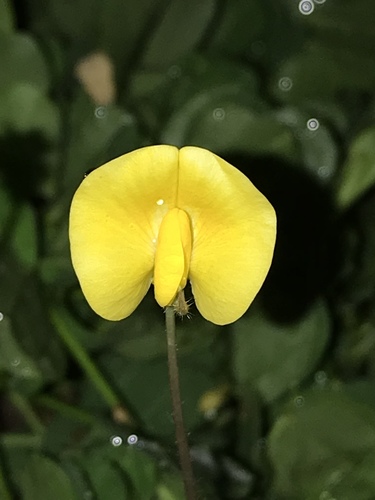
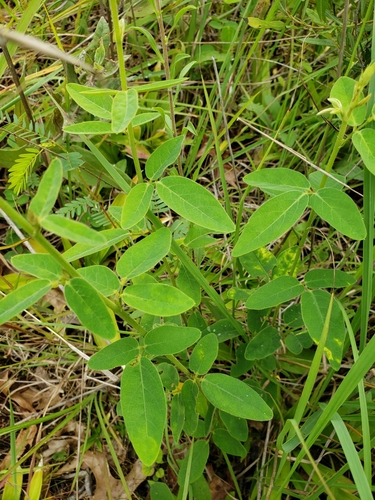
Desmodium obtusum (Muhl. ex Willd.) DC. is an erect perennial herb that reaches 0.5 to 1.2 meters in height. Its stems are densely covered in uncinate, or hooked, pubescence. Its leaves are trifoliolate; terminal leaflets range from oblong to ovate or elliptic, typically 2 to 3.5 centimeters long, occasionally reaching up to 4.5 centimeters long, and are around 1.8 to 2.2 times longer than they are wide. The upper surface of leaflets is short-puberulent to nearly glabrous, while the lower surface is more densely pubescent and has prominent reticulate veins. Stipules are lance-attenuate to ovate-lanceolate, 2 to 6 millimeters long, and deciduous early; stipels are persistent. Inflorescences are usually terminal panicles, covered in short pubescence to pilose, and hold purplish papilionaceous flowers with petals approximately 4 to 6 millimeters long. Stamens are diadelphous, with 9 fused and 1 free. The fruit is a stipitate loment made up of 1 to 4 weakly obovate to suborbicular segments. Each segment is 3 to 5 millimeters long and around 2.5 millimeters wide, slightly convex along the upper suture and broadly rounded below, and densely covered in uncinate pubescence on both surfaces. The fruit stipe is 1.5 to 3.5 millimeters long, longer than the calyx tube but shorter than the calyx lobes and stamen remnants. This species occurs from Massachusetts west to southern Michigan, and south to the Florida Panhandle and Texas. It grows in fields, longleaf pine sandhills, dry pine flatwoods, other dry pine woodlands, woodland borders, and disturbed areas. Desmodium obtusum flowers from June through September, and fruits from August to October. It grows well in frequently burned habitats, and benefits from spring prescribed fire.