About Desmodium lineatum DC.
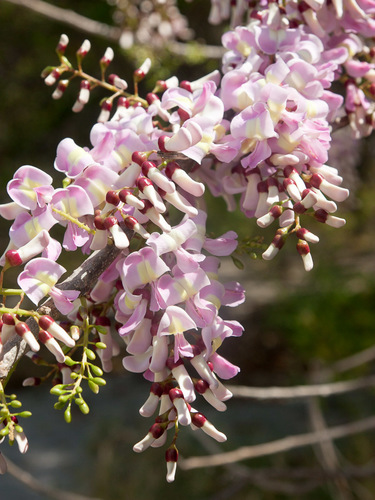
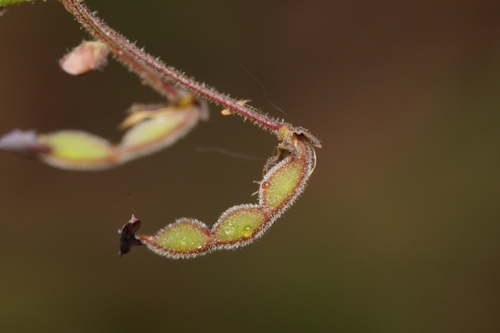
Desmodium lineatum DC. has stems that are 50 to 70 cm long, and range from covered in hooked uncinate pubescence to nearly hairless. Its terminal leaflets come in a variety of shapes: ovate, rhombic, obovate, elliptic, or orbicular. These leaflets measure 0.7 to 3 cm in length, and are approximately three-quarters as wide as they are long. Leaflet surfaces range from hairless to densely covered with short hooked hairs. The stipules are 2 to 5 mm long, marked with distinct parallel striations, and range in shape from lance-attenuate to linear-subulate; its stipels are persistent. The inflorescences are paniculate, and usually densely covered in fine hooked pubescence, with pedicels 6 to 16 mm long. Flowers have purplish petals that are 4 to 6 mm long, a calyx that is densely covered in fine pubescence and sparsely covered with longer hairs, and diadelphous stamens. The fruit is a stalked stipitate loment with 2 to 3 segments. Each segment measures 3.5 to 6 mm long and 2.5 to 3.5 mm wide, is straight to slightly curved along its upper edge and rounded along its lower edge, and has dense hooked hairs on both of its surfaces and along its sutures. The fruit's stipe is longer than the calyx tube, about the same length as the longest calyx lobe, and shorter than the remaining staminal structures. This species has the characteristic traits of its genus Desmodium, including entire stipellate leaflets, papilionaceous flowers that are subtended by bracts, and segmented, indehiscent loments. Desmodium lineatum ranges from southeast Maryland to northern peninsular Florida, and extends west to Texas. It is rarely found in inland areas. It grows in longleaf pine sandhills, as well as other types of dry forests and woodlands. It occurs in frequently burned upland shortleaf and longleaf pine native and old-field communities, and can also grow in fire-excluded habitat, which demonstrates it is not fully dependent on fire. It is able to regrow in reestablished native longleaf pine habitat that was previously disturbed by agricultural activity.