About Desmodium illinoense A.Gray
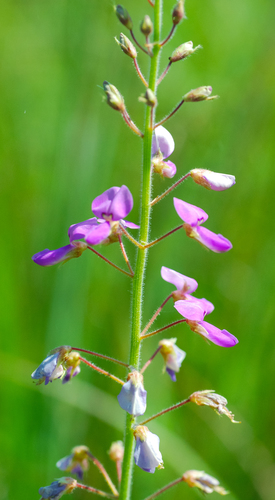
Desmodium illinoense is a perennial herb. It usually has a single simple stem that grows up to 1.2 meters (4 feet) tall. Most of its above-ground growth is covered in hooked hairs, which can make its leaves stick to each other. Its leaves are trifoliate, and can grow up to 6.3 centimeters (2.5 inches) long. The leaflets are rounded, with a blunt tip. The calyx lobes of its flowers are equal in length to or longer than the corolla tube. The inflorescence grows at the end of the stem, and is most often unbranched. The flowers range from white to pink, with a small number of white spots near their center. Flowering occurs from June to September. Its seed pods are split into sections called loments. The outer fruit layer is constricted between individual seeds, so when the pod is ripe it can easily break apart into single-seed segments. These segments are covered in hooked hairs, letting them easily attach to animal fur or clothing. They can be carried some distance before falling to the ground to germinate. Desmodium illinoense grows naturally mostly in prairies in the midwestern United States. The center of its native range covers the states of Missouri, Illinois, and Iowa. Its northern range boundary reaches southeastern Minnesota, from the Twin Cities area southward. In this region, it grows in full sun to partial shade, in sandy or gravelly soils found in savannas, hillside prairies, and barrens. In Minnesota, it can also be found in oak woodland openings, on dunes, and in thickets. It is listed as a threatened species in Minnesota, where all remaining small natural populations are few in number.