About Desmanthus leptolobus Torr. & A.Gray
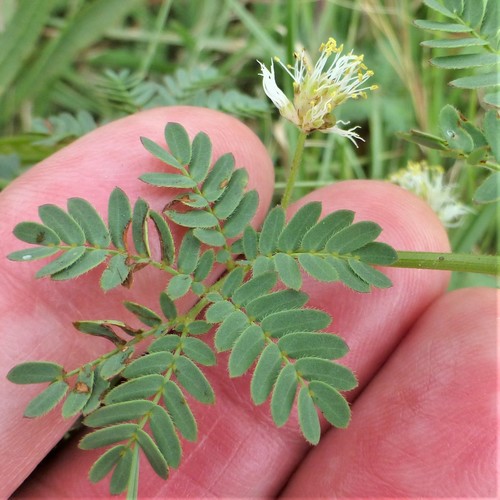
Desmanthus leptolobus grows easily from seed in USDA Hardiness Zones 5–8, and can tolerate freezes down to approximately -20 °C. Young plants of this species are usually erect, and become trailing or spreading as they mature. It produces a few to many red-green trailing stems that reach roughly one metre in length, along with a tapering cylindrical taproot that can grow up to one and a half metres long, with a diameter of one to two centimetres. Its leaves are typically 2.5 centimetres to 6 centimetres long. The species bears curved, pointed leaflets that measure approximately 2 to 5 millimetres long by 5 to 10 millimetres wide; the leaflets are narrowly elliptic to linear in shape, and arranged in 15 to 25 pairs. The seeds of Desmanthus leptolobus are thinner and more elongated than the seeds of its close relative Desmanthus illinoensis. The root bark of D. leptolobus has been found to contain the psychedelic compound DMT, as well as other related tryptamines. The only reported quantitative analysis of this species recorded a DMT concentration of 0.14%, which is lower than DMT concentrations found in Desmanthus illinoensis. However, one person documented a "subjectively stronger response" to D. leptolobus than to D. illinoensis. DMT concentrations are known to vary across Desmanthus species. D. leptolobus appears early as a component of reclamation vegetation on disturbed land, and it disappears rapidly once shrub and tree species become established.