About Desis marina (Hector, 1877)
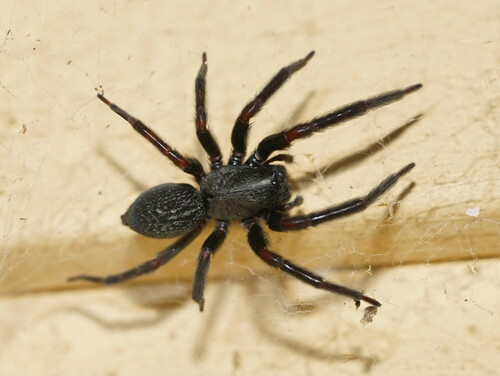
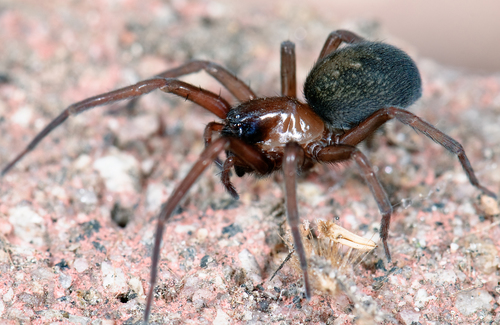
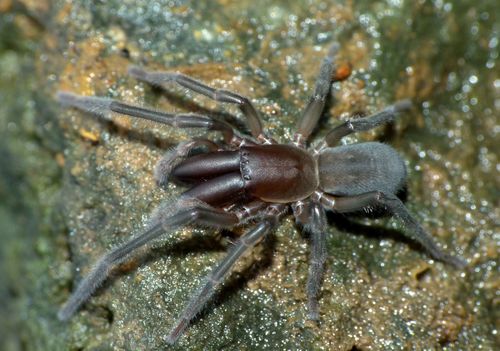
Male Desis marina measure over 8 mm in body length. Their cephalothorax (the fused head and thorax region) and chelicerae (fang-like mouthparts) are dark red-brown, while the abdomen is creamy grey with a near-greenish tint. The carapace, the upper section of the cephalothorax, is almost rectangular, and holds eight small eyes arranged in two rows. This eye group takes up just over half the width of the head. The sternum, the underside of the cephalothorax, is longer than it is wide, and has projections along its lateral margins. These projections sit opposite and between the coxae, the base segments of the legs. The chelicerae are proportionally very large, and bear two rows of teeth. The abdomen is covered in small pale hairs, with some longer hairs scattered across its entire surface. For the male pedipalp, the leg-like appendage used for mating, the cymbium (the segment at the end of the pedipalp) is pointed at its distal end and extends past the bulb. The tibial apophysis, a projection on the third pedipalp segment, is made up of a flat plate and a spine. Female Desis marina are similar in appearance to males, but are generally larger, reaching over 10 mm in body length, and have proportionally smaller chelicerae. This species is distinguished by its complex branched tracheal system, which is located just in front of the spinnerets. Morphological differences between different populations of this species have been recorded. Desis marina is native to New Zealand, including the Chatham Islands, and New Caledonia. Within New Zealand, it is widespread and appears to occur wherever suitable habitat is available. It inhabits the intertidal zone of rocky shores, where it builds silk retreats inside crevices, seashells, tubeworm burrows, and bull kelp holdfasts. After entering a retreat, the spider seals it shut. In this intertidal environment, the spiders and their silk retreats are regularly submerged in seawater. The spiders are most active at night, but are occasionally observed during the day.