About Deroplatys desiccata Westwood, 1839
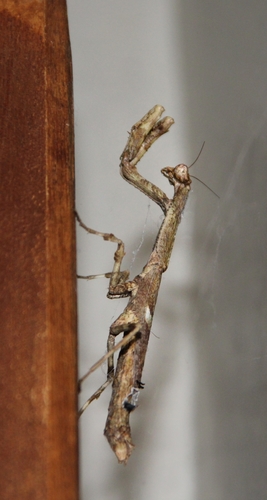
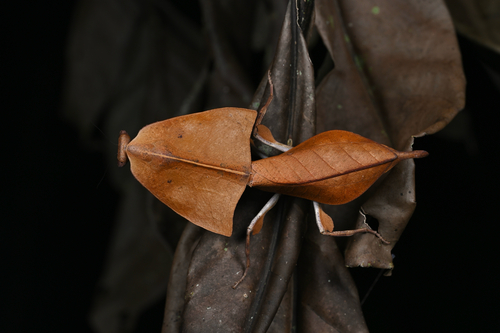
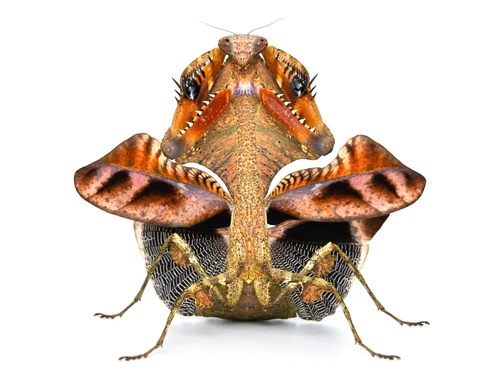
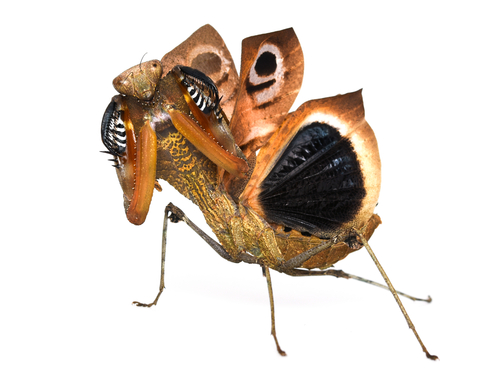
Deroplatys desiccata Westwood, 1839 gets its common name from its close resemblance to dead leafy vegetation. It has a flattened, greatly extended thorax and intricate leaf patterns on its wings. Its color ranges from mottled brown and pale orangey brown to very dark brown that is almost black. Both its appearance and its movements help it camouflage itself. When disturbed, it rocks gently like a leaf blowing in a breeze. When threatened, it typically falls to the ground and stays motionless. It may also use a threatening display: it splays out its black underwings to reveal large eyespots, which scares off unsuspecting predators. The intricate lines on its body mimic the natural veins of a leaf, and its dark brown coloration helps the species avoid detection by aerial predators and other insects. As its common name suggests, D. desiccata is larger than other dead leaf mantis species. Females reach 75 to 80 millimeters in length. Like most mantises, this species shows clear sexual dimorphism: males only grow to 65 to 70 millimeters long, and are substantially smaller and lighter than females. The prothorax shields of females end in a sharp pointed curve on each side, while males have a rounder shape. One source notes that males tend to be more yellowish than the darker females. D. desiccata lives in scrubland and tropical forests of Borneo, Indonesia, Malaysia, Sumatra and the Philippines.