About Deroceras reticulatum (O.F.Müller, 1774)
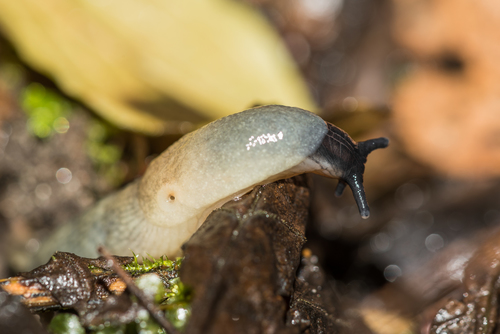
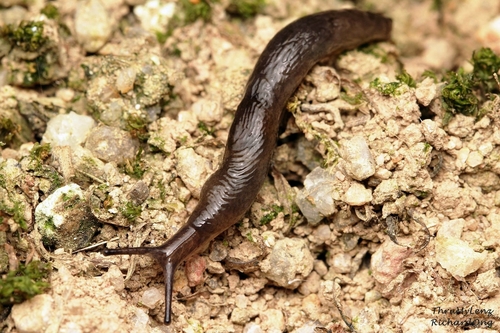
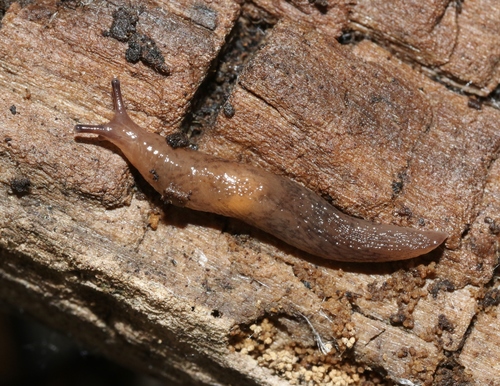
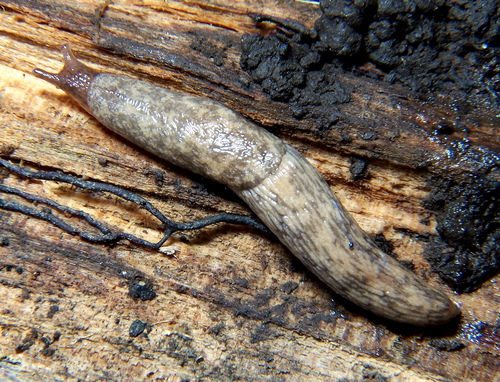
Like all other species in the Deroceras genus, Deroceras reticulatum (O.F.Müller, 1774) has a short keel at the back of its body. This species is highly variable in color, ranging from creamy to light coffee cream, and is rarely marked with blackish spots; spotted individuals may appear overall blackish. Behind the mantle, dark spots form a reticulate pattern. Its skin is thick. The mucus it produces is colorless, but becomes milky white when the slug is irritated. It is not possible to distinguish this slug from many other Deroceras species based on external appearance alone. Adults can reach 40–60 mm in length when alive; preserved specimens measure 25–30 mm, and overall size varies depending on habitat. In its reproductive system, the penis is fleshy with a silky sheen, shaped like an irregular sac. In fully mature specimens, a deep lateral constriction divides the penis into two parts. The penial gland has a highly variable shape, usually with a few branches or forming a single long branch. The stimulator is large, conical, and narrow. The penis retractor inserts laterally. The vas deferens opens into the penis wall facing the external side of the body. The rectal caecum is large. This slug can travel up to 40 feet (12.2 m) in a single night. Deroceras reticulatum is native to Europe, North Africa, and the Atlantic Islands. It occurs widely across most of Europe, but is rarer and restricted to cultivated fields in southeastern Europe, particularly the Balkans, and is probably absent from Greece and the mountains of Bulgaria. It is likely the most widespread slug in northern and central European lowlands, as well as Great Britain and Ireland. In northern Scandinavia it is scarce, and occurs mainly as a synanthrope. Confirmed locations for this species include Great Britain, Ireland, Austria, Spain, Bulgaria, the Czech Republic (where it is listed as least concern, LC), the Netherlands, Poland, Slovakia, Sweden, Latvia, and Ukraine. This species has been widely introduced as a synanthrope to many other regions: parts of Northern and Southern Michigan and Kentucky in North America, Canada, Colombia, Peru, Argentina (where it is a major slug pest in Buenos Aires province), Saint Helena, Tasmania, New Zealand, and central Asia. Deroceras reticulatum is almost exclusively restricted to cultivated areas, and usually inhabits open habitats including meadows, roadsides, ruins, gardens, and parks. It does not occur inside forests. Its external appearance is very similar to Deroceras rodnae and Deroceras praecox, while its internal anatomy is very similar to Deroceras turcicum. All three of these related species live in natural woodland habitats, and co-occur with Deroceras reticulatum very rarely. The slug shelters under stones and ground litter, and does not burrow into soil. It is active at night. The full life cycle of Deroceras reticulatum spans a few months, and typically produces two generations per year. The main reproductive phase occurs in summer and autumn. Individuals lay hundreds of eggs, which hatch in early summer. The maximum lifespan of this slug is about one year. Slugs die when the first frosts of winter arrive. Usually only eggs overwinter, though juveniles may sometimes hibernate as well.