About Deroceras invadens Reise, Hutchinson, Schunack & Schlitt, 2011
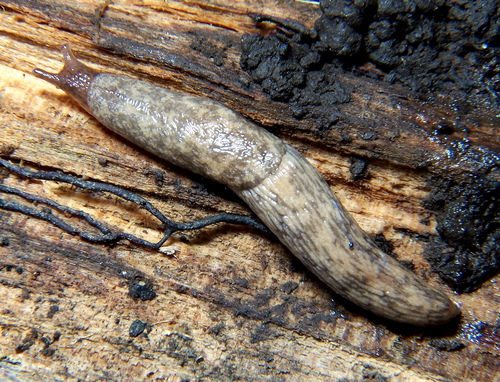
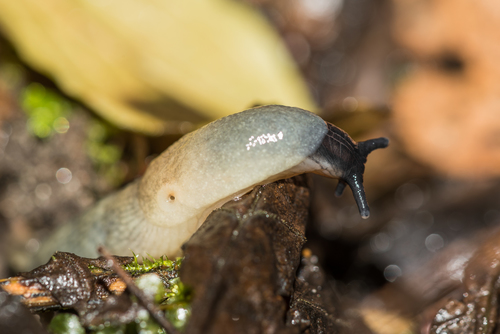
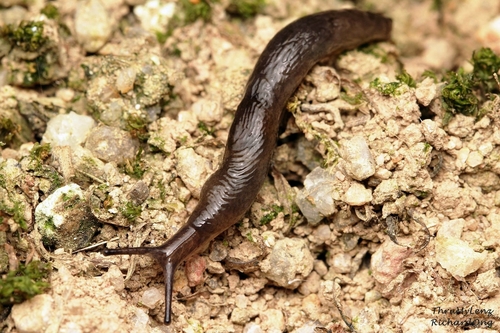
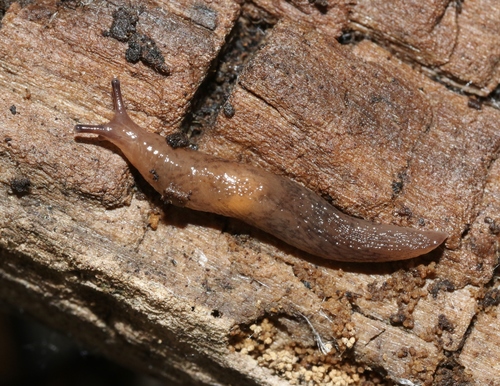
Adults of Deroceras invadens are typically 20–35 mm long. Their skin and flesh are watery, fairly transparent, and range in color from light greyish-brown to almost black. Close inspection reveals fine dark spotting across most of the body, which is more visible in alcohol-preserved specimens. Often (but not always) the respiratory pore is pale and unspotted, and the slug produces colorless mucus. In North America, some large Deroceras laeve can closely resemble D. invadens. Two external traits help distinguish the two: when disturbed or preserved, the tail end of D. invadens slopes vertically upward from the sole for a short distance, or even bends backward, while D. laeve’s tail slopes forward above the sole. Additionally, the tail of D. invadens is longer than its mantle, while D. laeve’s tail is the same length as or shorter than its mantle. Even with these external clues, dissection is required to reliably distinguish D. invadens from D. laeve and other similar European Deroceras species, including Deroceras sturanyi, the true Deroceras panormitanum, and Deroceras cecconii. Reise et al.’s original 2011 article discusses and illustrates the most important diagnostic anatomical traits. In most D. invadens populations, the proximal penis has two side pockets: the penial caecum and penial lobe. These two pockets have roughly equal widths and both have rounded, stout ends. A prominent attached penial gland with 3–7 branches connects between the caecum and lobe on the dorsal side; these branches have a less knobbly outline than those of D. panormitanum. The penial retractor muscle attaches between the caecum and lobe on the ventral side. The intestinal caecum is either absent, or only present as a widening of the rectum. Barker (1999) and Sirgel (1973) provide detailed descriptions of other aspects of this species’ anatomy. Hutchinson et al. (2014) published an extensive review of D. invadens’ distribution. Its native range is southern, and possibly central, Italy, but the first confirmed record of the species came from Britain in 1930. Today D. invadens occurs across many other regions of the world, with only one confirmed record from Asia to date. First reported outdoor finds (unless stated otherwise) are listed below, with oceanic islands separated at the end. In Europe: Italy (native to the south, including parts of Sicily), Great Britain (1930), Denmark (1937), France (1945), Sweden (c. 1957 in greenhouses, ≤1980 outdoors), Ireland (1959), Finland (≤1961 in greenhouses, ≤2014 outdoors), Norway (1967 in greenhouses, 1983 outdoors), Belgium (1968), Netherlands (1969), Spain (1974, with an earlier record from the Canaries), Portugal (1977, with an earlier record from the Azores), Austria (1977), Germany (1978), Switzerland (1982), Czech Republic (1996), Luxembourg (1997), Andorra (≤2000), Poland (2001), Slovakia (2003 in greenhouses, 2018 outdoors), Russia (2009 in greenhouses, Tver Oblast), Greece (2011), Monaco (2012), San Marino (2013), Montenegro (2014), Liechtenstein (2014), and Hungary (2019; a 1974 report was retracted by its original author). Due to taxonomic confusion before 2011, older records of "D. panormitanum sensu lato" from southeastern Europe (e.g. Bulgaria, parts of Greece) need rechecking, and records from Romania and Lithuania are either erroneous or unconfirmed. In Africa: South Africa (1963), Egypt (2005–2007), Kenya (2012, found on exports to the USA). In Asia and Australasia: Israel (2013, greenhouse), Australia (1936), New Zealand (1974, with circumstantial evidence of an much earlier introduction and a slightly earlier record from Raoul Island). In North America: USA (California 1940, Washington State and Oregon 2001, Colorado 2004, Utah 2006, Washington D.C. 1998); Canada (Quebec greenhouses 1966, British Columbia 1974, Alberta 2021, Newfoundland 2012; records from Ontario require confirmation); Mexico (1974). In Central and South America: Costa Rica (2006), Panamá (2007, found on exports to the USA), Colombia (1975), Ecuador (2012, found on exports to the USA in 2004), Peru (2012, found on exports to the USA), Chile (≤2003, with an earlier record from Juan Fernández Islands), Argentina (2004), Brazil (1991). For oceanic islands: Faroe Islands (Denmark, 1970), Madeira (Portugal, 1980), Azores (Portugal, 1957), Canary Islands (Spain, 1947), Tristan da Cunha (UK, 1982), Raoul Island (New Zealand, 1973), Chatham Islands (New Zealand, 1976), Lord Howe Island (Australia, 2000), Norfolk Island (Australia, 2013), Marion Island (South Africa, 1972), Juan Fernández Islands (Chile, 1962). Deroceras invadens typically inhabits disturbed sites, where it is most easily found under rubbish. By the 1980s it was already the most widespread slug species in Manchester gardens, and a 2020–2021 survey of gardens across Britain found it present in a higher proportion of gardens than any other slug species. Despite this preference for disturbed areas, it has also spread into natural habitats including woodland and grassland in regions like Britain, Tenerife, South Africa and Australia. It prefers areas with high humidity and cannot survive temperatures below –7 °C. Low winter temperatures appear to limit its distribution, which may explain why its colonization of central Europe has been slow and partial, and why it has recently expanded its range in Sweden following climate warming. D. invadens can be a significant pest in gardens, greenhouses, pasture, and arable fields. In captive conditions, individual slugs can eat their own body weight in lettuce over two to three days. In North Wales, most adult D. invadens begin laying eggs in autumn and die by early spring. While the species can be found year-round, it reaches peak abundance in late spring. In New Zealand pastureland, populations drop substantially in summer. In agricultural fields in northern Italy, D. invadens is commonly trapped from November to May, and is not found at all in summer. A wild-collected D. invadens specimen has been found hosting larvae of the lungworm Angiostrongylus vasorum, the parasite that causes canine angiostrongylosis, a serious disease for domestic dogs.