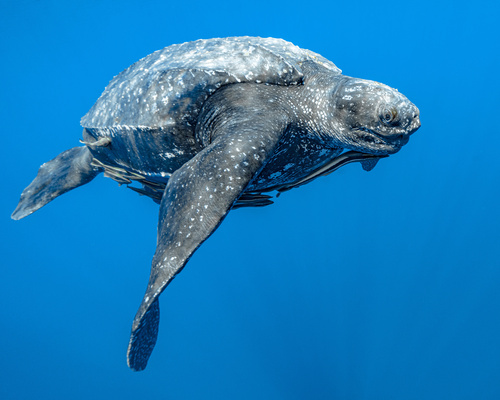
About Dermochelys coriacea (Vandelli, 1761)
The leatherback sea turtle, with the scientific name Dermochelys coriacea, is sometimes also called the lute turtle, leathery turtle, or simply the luth. It is the largest of all living turtles and the heaviest non-crocodilian reptile, reaching maximum lengths of 2.7 metres (8 ft 10 in) and weights of 500 kilograms (1,100 lb). It is the only living species in the genus Dermochelys and the family Dermochelyidae. It can be easily told apart from other modern sea turtles by its lack of a bony shell; instead, its carapace is covered by oily flesh and flexible, leather-like skin, which gives the species its common name. Leatherback turtles have a global range, with multiple distinct subpopulations. The species as a whole is considered vulnerable, and some of its subpopulations are classified as critically endangered. The leatherback turtle is a species with a cosmopolitan global range. Of all living sea turtle species, D. coriacea has the widest distribution, ranging as far north as Alaska and Norway and as far south as Cape Agulhas in Africa and the southernmost tip of New Zealand. The leatherback is found in all tropical and subtropical oceans, and its range extends well into the Arctic Circle. Three major, genetically distinct populations exist in the Atlantic, eastern Pacific, and western Pacific Oceans. While nesting beaches have been identified in the Indian Ocean region, leatherback populations there remain generally unassessed and unevaluated. Recent estimates put the annual global number of nesting females at 26,000 to 43,000, a dramatic decline from the 115,000 estimated in 1980. Leatherback sea turtles are found primarily in the open ocean. Scientists have tracked a leatherback turtle that swam from Jen Womom beach in Tambrauw Regency, West Papua, Indonesia to the United States on a 20,000 km (12,000 mi) foraging journey that lasted 647 days. Leatherbacks follow their jellyfish prey throughout the day, which leads them to prefer deeper water during the daytime and shallower water at night, when jellyfish move upward through the water column. This hunting strategy often puts the turtles in very cold waters. One individual was found actively hunting in waters with a temperature as low as 0.4 °C (32.7 °F). After each foraging dive, the leatherback returns to warmer surface waters of 17.5 °C (63.5 °F) to regain body heat before diving again into near-freezing waters. Leatherback turtles are known to chase prey deeper than 1000 m, beyond the physiological limits of all other diving tetrapods except for beaked whales and sperm whales. Their preferred breeding beaches are mainland sites facing deep water, and they appear to avoid sites protected by coral reefs.

