About Dermestes frischi Kugelman, 1792
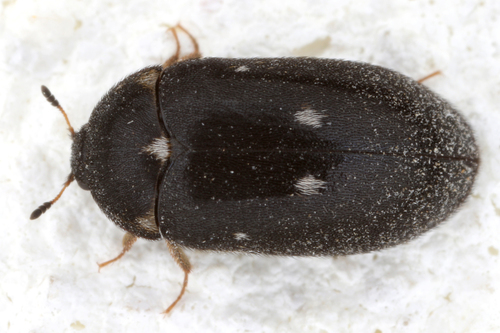
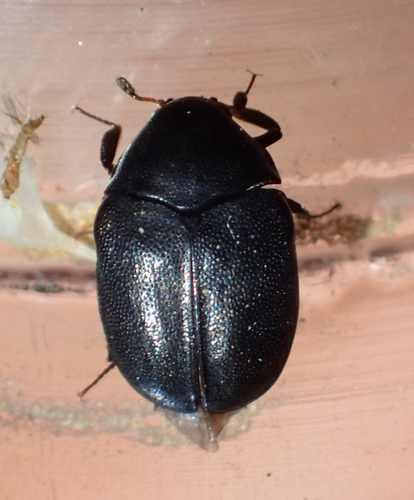
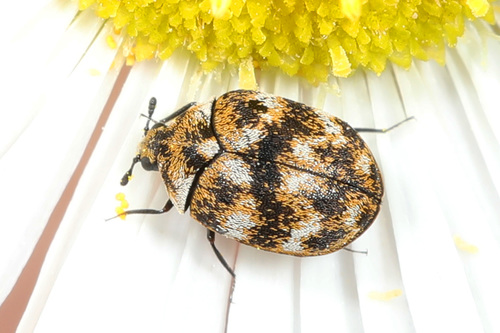
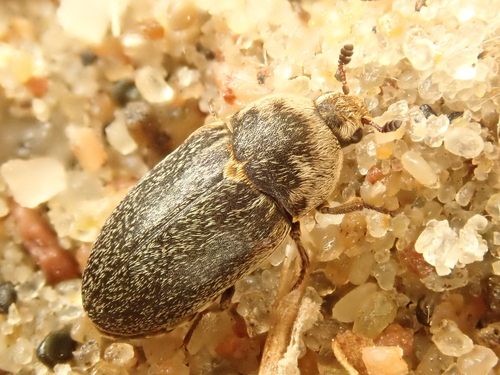
Dermestes frischi Kugelman, 1792 adults are 6–9.5 mm long, black to dark brown, and oval-shaped. The sides of the pronotum are covered in yellowish-white hairs. Their antennae are 11-segmented, with the final 3 segments forming a club. Adults can be sexed by the presence of a tuft of black-brown hairs in the center of the fourth abdominal sternite in males; this tuft is absent in females. Mature larvae measure 13–15 mm long. They are dark overall, with a pale band running along the dorsal surface of the body, and are covered in reddish-brown hairs of varying lengths. A pair of anteriorly curving horn-like protrusions called urogomphi are located on the ninth abdominal segment. D. frischi larvae are similar to larvae of Dermestes maculatus, but differ in that their dorsal band is disrupted on the prothorax, while D. maculatus larvae have an uninterrupted dorsal band. In the species’ life cycle, adult females start laying eggs in spring. Over a 2-month period, a female can lay between 40 and more than 400 eggs. Eggs are deposited on animal-derived materials such as carrion, dried meat, and dried fish, which serve as food for hatching larvae. Larvae emerge 5–9 days after eggs are laid, and immediately begin feeding and growing. Larval development includes 5 to 9 instars. When development is complete, larvae stop feeding, seek shelter inside the food material, and pupate. The pupal stage lasts approximately 10 days, after which new adults emerge. Development rate is primarily influenced by temperature: D. frischi develops faster and goes through fewer instars at 26 °C than at 23 °C.