About Dermatolepis dermatolepis (Boulenger, 1895)
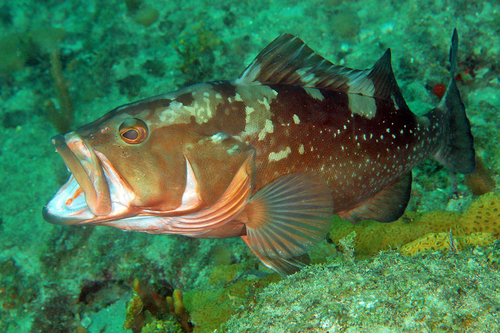
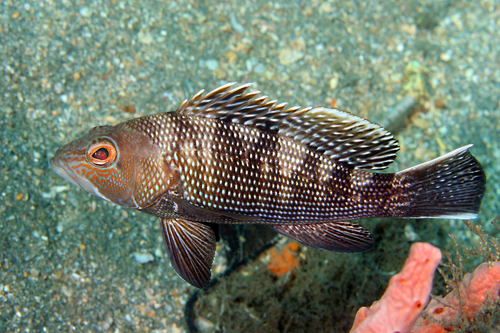
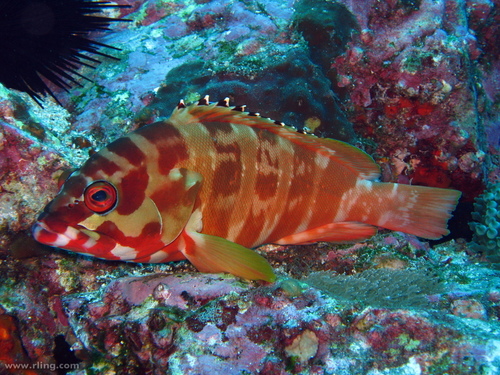
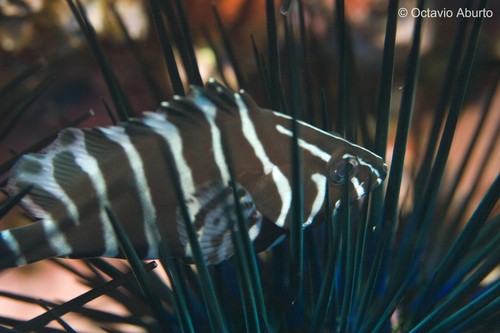
Dermatolepis dermatolepis (Boulenger, 1895) has a body at least twice as deep as its standard length, deepest at the origin of the dorsal fin, and is laterally compressed. It has a steep dorsal head profile, and the eye diameter is smaller than the snout length. The caudal fin is rounded, and the pectoral fins are short. The dorsal fin has 11 spines and 18 to 20 soft rays, while the anal fin has 3 spines and 9 soft rays. Adult individuals have a greyish-brown body marked with alternating dark grey to blackish and white to pale grey bars, mottled by numerous white to pale blotches. The fin margins have thin yellow bands. Juveniles are black with narrow white stripes running across the head and body that extend onto the dorsal and anal fins, and have a white caudal fin marked with black spots. The maximum recorded total length of this species is 100 centimetres (39 in), and the maximum recorded weight is 125 kilograms (276 lb). This species is found in the eastern Pacific Ocean along the western coast of North and South America, ranging from southern California to Peru. It also occurs around the Galapagos Islands, Revillagigedo Islands, Cocos Island and Clipperton Island. Dermatolepis dermatolepis inhabits coral and rocky reefs down to at least 50 metres (160 ft), and is likely found at much greater depths. Small juveniles may shelter among the long spines of sea urchins from the genera Centrostephanus and Diadema. This is a diurnal predator that feeds primarily on small benthic fishes, and occasionally on crustaceans. It associates with browsing herbivorous fishes, hiding among them to feed on small animals disturbed by the browsing herbivores. It has also been observed following foraging moray eels to prey on fish that flee from the eels. This species forms schools and synchronized spawning aggregations that contain around 30 to 70 individual fish. Spawning aggregations have been recorded from late November to February over a seamount off Cocos Island, and spawning has also been observed at Manuelita Island near Cocos Island in late July. In Mexico’s Revillagigedo Islands, spawning aggregations of 30 to 54 individuals have been recorded in February over a shallow seamount.