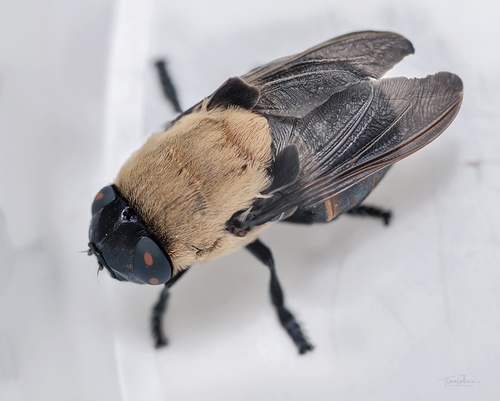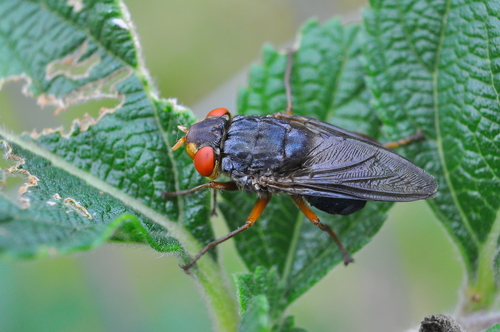
About Dermatobia hominis (Linnaeus, 1781)
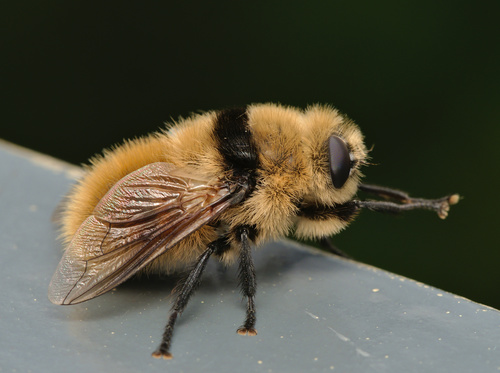
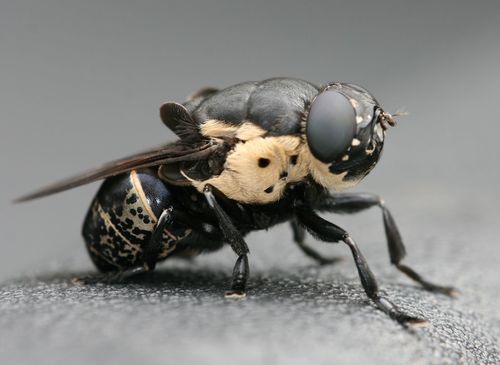
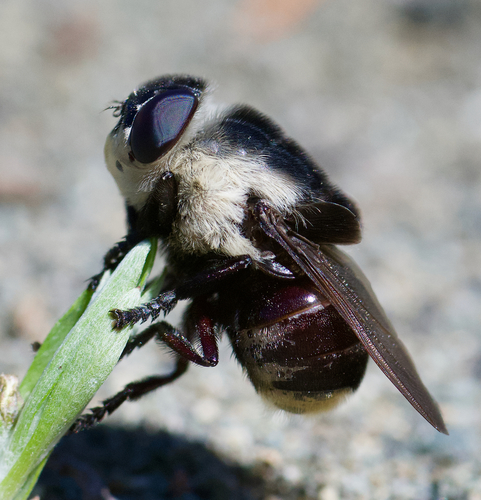
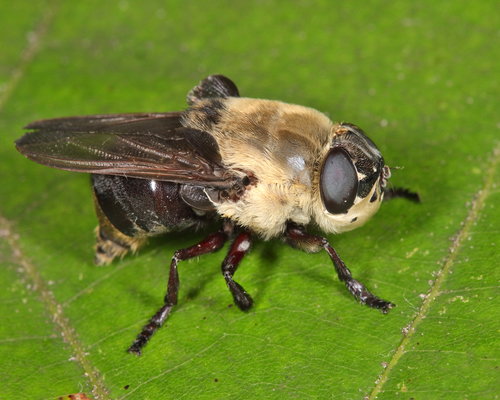
The human botfly, Dermatobia hominis, whose scientific name combines Greek words for skin and life and the Latin word hominis meaning of a human, is a species of botfly whose larvae parasitize humans alongside a wide range of other animals, including other primates. It is also called the torsalo or American warble fly, even though the true warble fly belongs to the genus Hypoderma rather than Dermatobia, and is a parasite of cattle and deer, not humans. Over 40 species of mosquitoes and muscoid flies, plus one tick species, have been documented as vectors for Dermatobia hominis eggs. This information on tick vectors comes from a 2007 source; slightly more recent literature does not indicate the species requires a particular tick species, and does not mention that only one tick species can act as a vector. The female human botfly captures a mosquito, attaches its eggs to the mosquito's body, then releases the mosquito. Eggs can hatch while the mosquito feeds, and larvae use the mosquito bite area as an entry point into a host. Alternatively, eggs can simply drop off a muscoid fly when the fly lands on host skin. Larvae develop inside the host's subcutaneous layers. After approximately eight weeks, the larvae drop out of the host to pupate for at least a week, typically in soil. Adult human botflies are large flies that lack mouthparts, which is consistent with other oestrid flies. This species is native to the Americas, ranging from southeastern Mexico starting in central Veracruz to northern Argentina and Uruguay. It is not abundant or harmful enough to qualify as a true pest. Normally, the greatest risk this species poses to humans is an increased chance of infection. Fly larvae can only complete their full eight-week development if the wound they occupy does not become infected, so patients rarely get infections unless they kill the larva but fail to remove it completely from the wound.