About Dermacentor andersoni Stiles, 1908
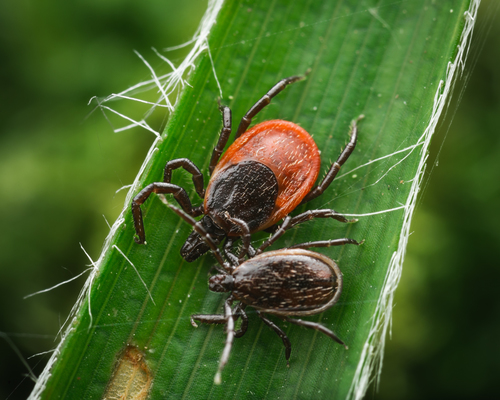
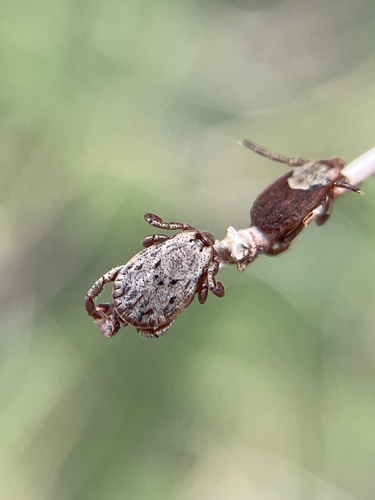
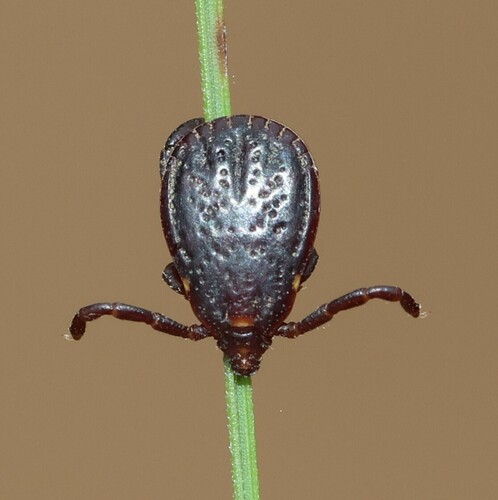
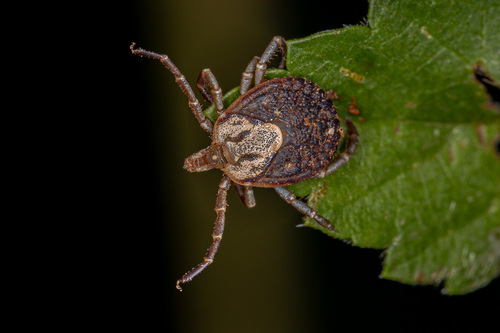
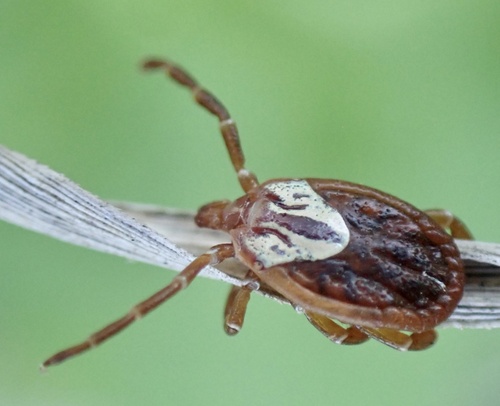
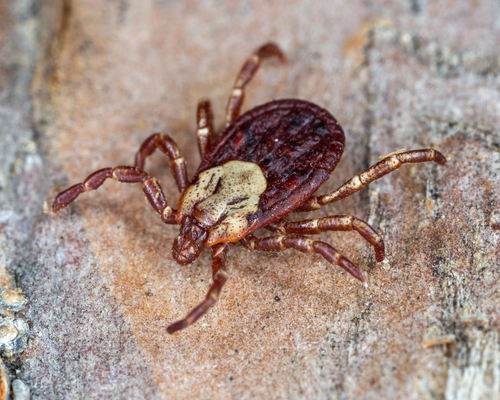
Morphology of Dermacentor andersoni, commonly known as the Rocky Mountain wood tick, describes these hard ticks as generally brown or reddish brown in color. Females have distinct dorsal silver-gray ornamentation that becomes grayer when the tick feeds, while males have gray and white spotting with no distinctive shield marking. Their bodies are flat and pear-shaped, ranging in length from 2.0 to 5.3 mm, and have 11 festoons on their lower dorsal portion. This species is sexually dimorphic: females are generally larger, and can increase their size by nearly three times when fully engorged. It is also polymorphic, with substantial physical variation between individuals. Features that distinguish this species from other ticks relate to the number and size of goblets, the respiratory structures on its spiracular plates; D. andersoni typically has an average of 100–200 goblets, a trait only observable under a light microscope. Life cycle: Dermacentor andersoni is a three-host tick with three life stages: larval, nymphal, and adult. In each life stage, the tick takes a single blood meal from a mammalian host. The total lifecycle duration ranges between 1 and 3 years, and is affected by factors including temperature, humidity, and host availability. From early May through June, engorged female ticks drop off their hosts and deposit their eggs on moist vegetation. A single female lays approximately 2500–4000 eggs over a period of 10–33 days. Larval ticks hatch in early summer and begin questing for small mammalian hosts, responding to stimuli of carbon dioxide, light, temperature, and humidity. A larva may cling to a passing host with its first pair of legs, climb upwards, then attach to the host’s neck or shoulder region using its gnathostome. Larvae feed for roughly 2–6 days. After becoming engorged, larvae drop off the host and molt into nymphs. Nymphs stay dormant for extended periods unless stimulated by the presence of a host. Nymph feeding behavior matches that of larvae. Neither nymphs nor larvae feed on humans, but adult ticks do. When adults find and attach to a host, adult females feed continuously for around 5–15 days. Males feed for a shorter period, and mate with multiple partially fed females that remain on the host. Once fully engorged, females drop off the host and find a suitable area to lay eggs. Both sexes die shortly after reproduction.