About Depressaria apiella Hübner, 1801
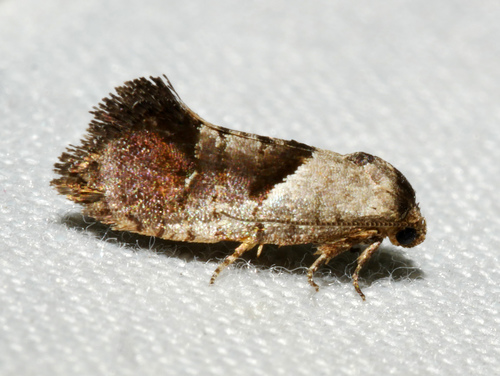
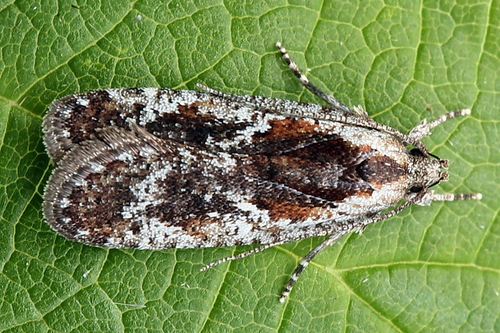
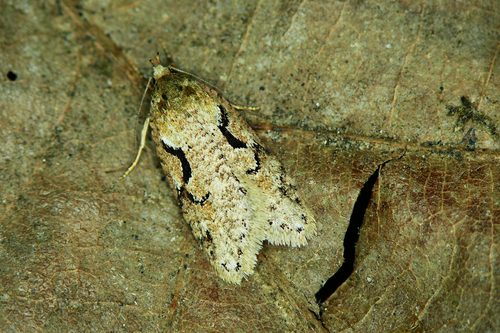
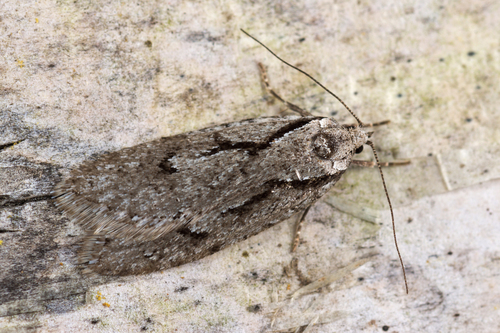
Depressaria daucella is a moth species in the family Depressariidae. It is present across most of Europe, excluding most of the Balkan Peninsula, and it is also found in North America. This species has a wingspan of 21 to 24 mm. The terminal joint of its palpi features two blackish bands. Its forewings are light brown, with some light whitish speckling, and sometimes have a faint reddish tinge. The forewings bear numerous dark fuscous dashes, two of which mark the discal stigmata; a line of pale scales sometimes appears between these two marks. An obscure, very sharply angled pale fascia is located at the 3/4 position of the forewing. The hindwings are fuscous-whitish, becoming darker fuscous toward the posterior edge; vein 5 is connate with the stalk of veins 3 and 4. Full-grown larvae are dark bluish-grey, with an orange yellow lateral line. The larvae's spots are black and outlined with a white ring; they have a black head, and the sclerotized plate on the second segment is black, divided into two parts, with a whitish edge along its anterior margin. Adult moths begin flying in September, and after overwintering, they continue flying into April. The larvae of this species are leaf miners, and they feed on a range of plant species: Sison amomum, Carum verticillatum, Cicuta virosa, Oenanthe aquatica, Oenanthe crocata, Oenanthe fistulosa, and Oenanthe pimpinelloides. Larvae can be found feeding from June through the end of July.