About Deparia acrostichoides (Sw.) M.Kato
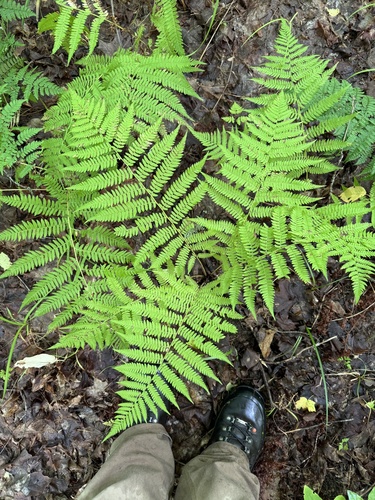
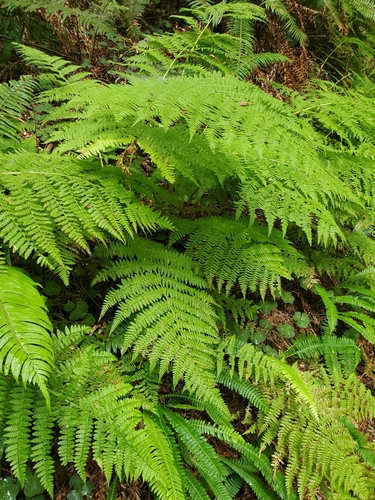
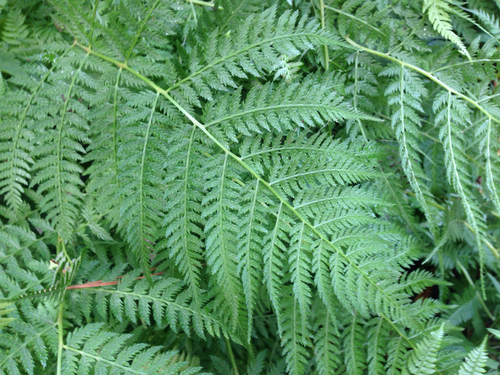
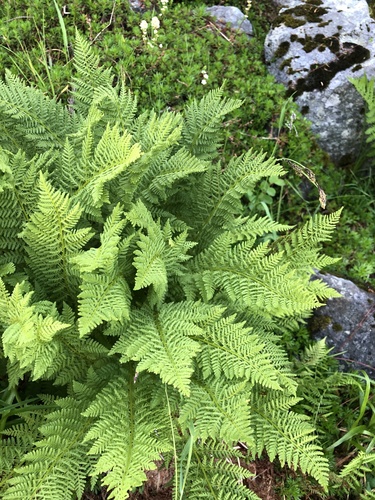
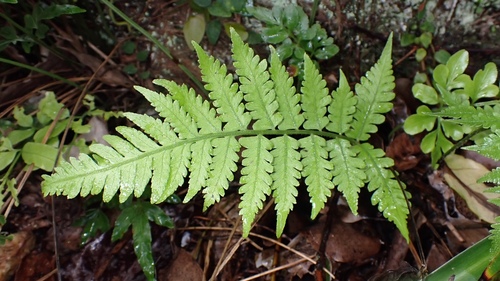
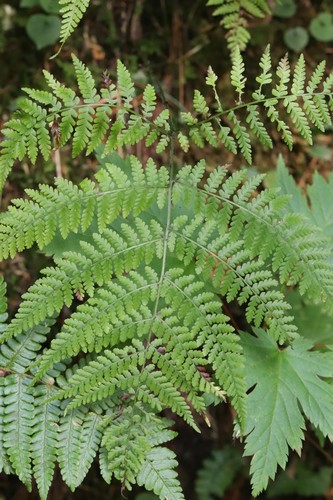
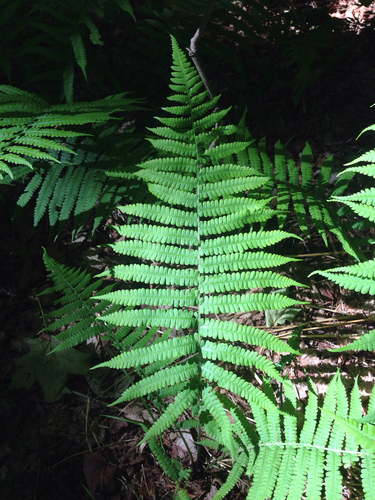
Deparia acrostichoides, commonly called silvery spleenwort, has yellowish-green pinnately divided leaves that grow from a stout, green stem. This stem is lightly covered in brown hairs and scales, is grooved along its upper side, and is much shorter than the leaf blade. The stem is darker at its base, appearing dark red or brown, and fades to pale green as it approaches the leaflets. The leaves are widest at their middle, with a long pointed tip and a tapering base. The lowest pair of leaflets on each leaf typically point downward, a trait that can be used to distinguish this fern from similar species. Mature leaves measure 30–80 cm (12–31 in) long and 10–25 cm (3.9–9.8 in) wide, and their lower surface is covered in fuzzy yellow-green hairs. Each leaf holds approximately 18 leaflets, which are roughly 15 cm (5.9 in) long and 1 cm (0.39 in) wide and relatively straight. Leaflets are further divided into oblong subleaflets with blunt or rounded tips. Sterile and fertile leaflets have the same general shape. Fertile leaves produce sori on their underside; these sori are initially silvery green, turning light brown when they ripen. Sori are arranged pinnately on subleaflets to follow the leaf vein pattern, are typically straight or slightly curved, and have a thick indusium with an unbroken margin. The fertile pinnae are described as acrostichoid, meaning sporangia cover almost the entire lower surface of the leaf. This acrostichoid trait gives D. acrostichoides its species epithet. Silvery spleenwort grows from creeping roots and often forms large, extensive colonies. Within its range, it is a common fern found in stream bottoms, moist woods, and cool shaded areas.