About Denisonia devisi (Waite & Longman, 1920)
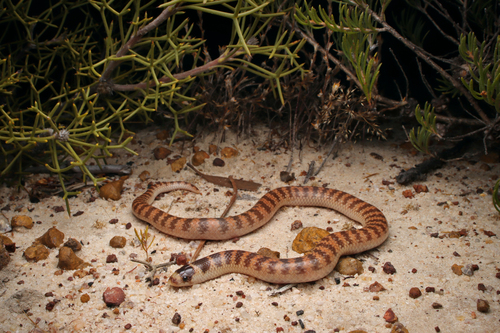
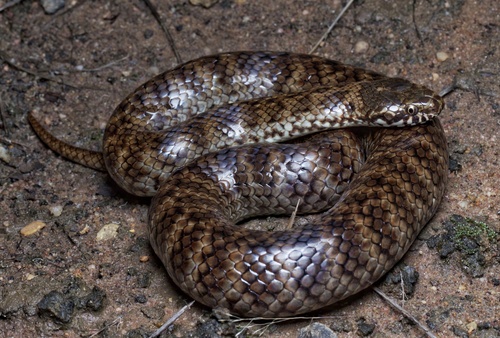
Denisonia devisi, also known as De Vis' banded snake, has a short, thick, slightly flattened body. Its eyes are positioned on the top of the head, with a distinctly noticeable iris. The dorsal surface of its body ranges from yellowish-brown to olive-green, marked by irregular, ragged-edged, narrow dark bands that cross the body. This species is sometimes mistaken for death adders, because both snakes have thick, banded bodies. The key distinguishing features are that De Vis' banded snake does not have an abruptly tapering tail, and its head is not broad and triangular. Originally, De Vis' banded snake was believed to only live on alluvial flats in Queensland and New South Wales. When mammal expert Peter Menkhorst reported a sighting of a death adder in north-west Victoria, an expedition to survey the Wallpolla Islands was held in November 2005. The survey did not find a death adder, but instead recorded De Vis' banded snake for the first time in Victoria. Further confirmation of the species' expanded range came from a report on the results of environmental water level increases at several sites along the Murray River on the Victoria-New South Wales border, which specifically noted the presence of the snake. The snake was found in Wallpolla Island Park, a 9,800-hectare (24,000-acre) area of floodplain vegetation located in extreme north-west Victoria, on the Victoria-New South Wales border. This park is a designated "Icon Site", an area of high ecological value within the Murray-Darling basin. It is thought the species was carried south into Victoria by Darling River flooding. Over time, the normally dry habitat became more suitable for the snake as water availability and biodiversity increased due to the addition of environmental water. In late 2021, the South Australian Museum confirmed sightings of multiple De Vis' banded snakes at Chowilla Game Reserve, near Renmark in South Australia's Riverland region. These sightings marked the first confirmed record of the species in South Australia.