About Dendropsophus ebraccatus (Cope, 1874)
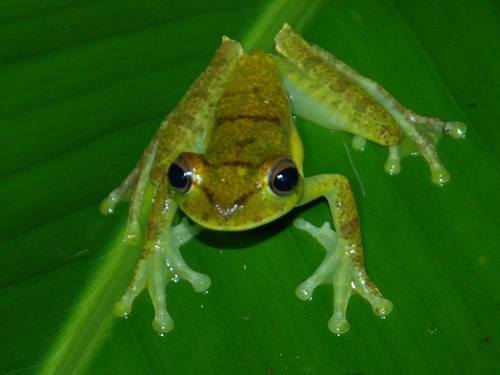
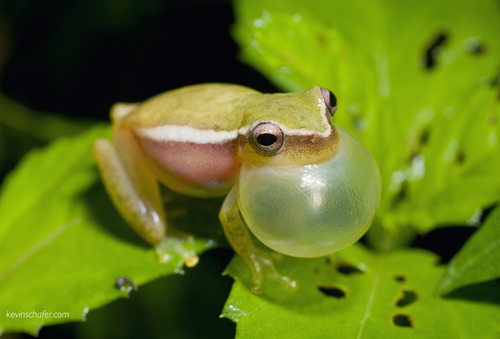
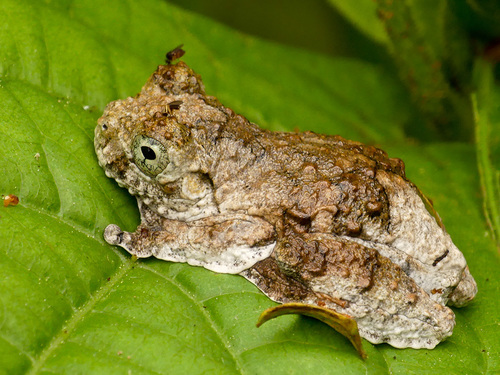
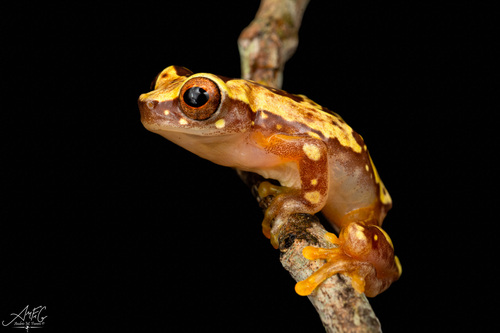
Dendropsophus ebraccatus (Cope, 1874), commonly called the hourglass tree frog or pantless tree frog, is a small, smooth-skinned treefrog that exhibits sexual dimorphism, with males significantly smaller than females. Its dorsal skin has a bright yellow background overlaid with darker blotches and spots that can range in color from yellow and gold to brown; these blotches often take the shape of an hourglass. Dorsal color patterns fall into four categories: hourglass with spots, hourglass without spots, spots, and plain, with the hourglass pattern being dominant in most populations. The species earned the common name "pantless frog" because when its hind legs are extended, the dark patterned dorsal blotches do not continue onto the thighs, which instead are covered in pale-yellow skin, giving the appearance of the frog wearing no pants. Relative to its body proportion, the hourglass tree frog has relatively large forelimbs, well-developed toe discs for climbing trees (its toe pads adhere via deformation of soft epithelial cells), and long hind limbs for jumping between trees. Unlike most anurans, while most of its gas exchange intake occurs through its nostrils, it releases most carbon dioxide through its permeable skin. This species is native to the Americas, found in specific regions of southern Mexico: southern Veracruz, northern Oaxaca, Chiapas, Tabasco, and the Yucatán Peninsula. It is also commonly observed across the more southern countries of Guatemala, Belize, Costa Rica, and Panama, with only a few known populations in Nicaragua and Honduras, and frequent sightings across northern Colombia and northwestern Ecuador. For reproduction, hourglass tree frogs migrate to vegetated freshwater pools to breed during the rainy season between May and November across Central and South America. Once aggregated around these pools, they use chorusing as a mate selection strategy. During the night, males hide behind foliage along the edges of marshes and ponds and produce long mating calls to attract female mates. After a female selects a male, the male climbs onto the female's back and releases sperm into her cloaca. Females reproduce multiple times within a single breeding season, with gaps between reproductive events as short as 10 days. In a single night, a female will lay a total of 180 to 300 eggs, split between up to eight separate egg masses. Dendropsophus ebraccatus has unique reproductive plasticity, allowing it to lay both aquatic and arboreal eggs. Egg clutches are deposited either as single layers on the upper surface of leaves that overhang freshwater, or as clusters attached to floating vegetation within the water itself. Arboreal eggs placed on overhanging leaves allow newly hatched tadpoles to roll directly into the water, while aquatic eggs attached to floating vegetation stay afloat and do not sink.