About Dendropsophus bogerti (Cochran & Goin, 1970)
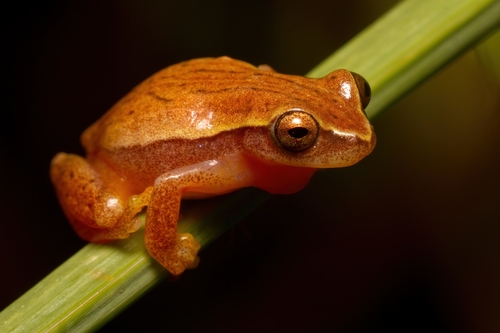
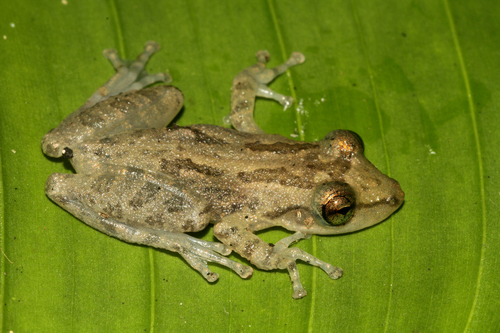
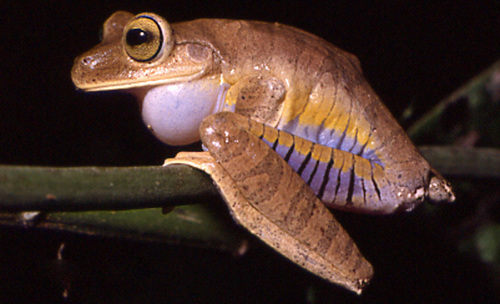
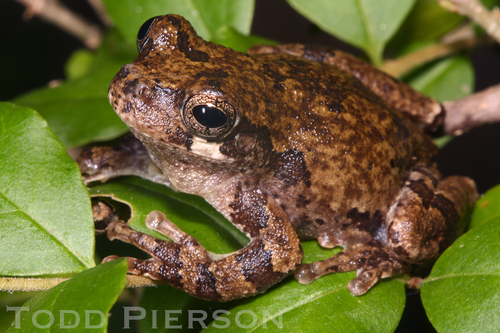
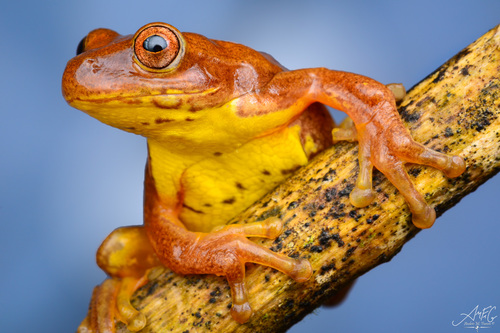
Dendropsophus bogerti is a species of frog first formally described by Cochran & Goin in 1970. For measured individuals from a Chocó sample, three adult males had a snout-to-vent length (SVL) of 25–26 mm (0.98–1.02 in), and one adult female had an SVL of 31 mm (1.2 in). In a second sample of 11 unsexed adults that included the species holotype, SVL ranged from 31 to 34 mm (1.2 to 1.3 in). This frog has a short, rounded snout, a very indistinct tympanum, webbing only at the base of its fingers, and webbing covering slightly more than half the length of its toes. Coloration is sexually dimorphic: the dorsal surfaces of the body and limbs are dull yellowish green in males, and pale golden brown or beige in females. The concealed surfaces of the limbs are bright orange. The throat is bright yellow, while the belly and posteroventral section of the flanks are pale brownish yellow, and the iris is coppery. The tadpoles of Dendropsophus bogerti have ovoid bodies that are wider than they are tall. Their bodies are dark brown, with blue, gold, and purple iridescence on the anterior portion and golden spots on the dorsal surface. Their fins are coppery brown, and their tails are xiphicercal, meaning they narrow abruptly to a clear flagellum. At Gosner stage 34, tadpoles measure 14–15 mm (0.55–0.59 in, rounded to 0.6 in in the original text) in body length, which makes up approximately 41% of their total length. This is an adaptable, very common species that lives in open areas including secondary forest and pastureland, at elevations between 1,500–2,580 m (4,920–8,460 ft) above sea level. Females deposit their eggs in temporary or permanent pools. The species faces no known identified threats, but it has never been recorded within protected areas.