About Dendropicos griseocephalus (Boddaert, 1783)
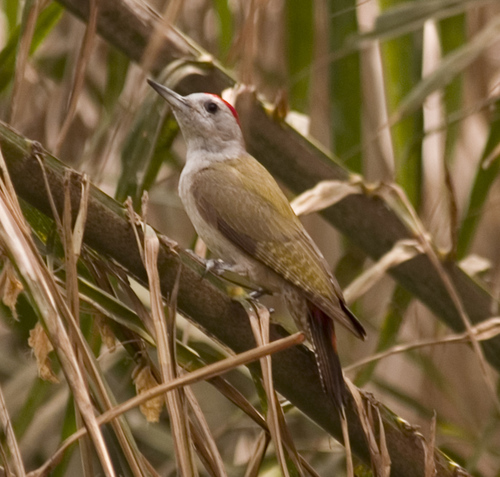
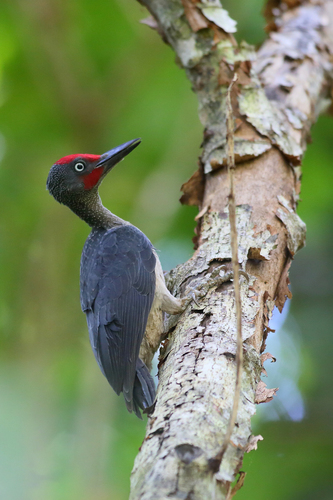
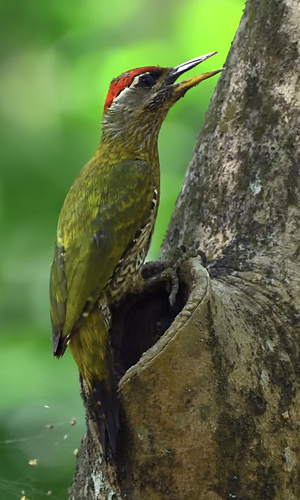
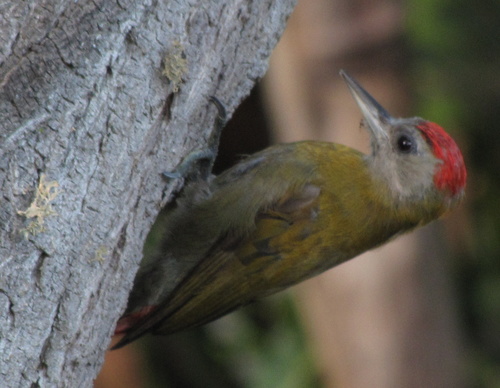
The olive woodpecker (Dendropicos griseocephalus) is mostly plain in appearance, lacking many of the patterns typically seen in other woodpecker species. It is distinguished by a bright scarlet rump and upper-tail coverts, which are most easily seen when the bird is in flight. These scarlet feathers often have grey bases and black subterminal bars. The bird has darkish grey forecrown, hindneck, chin, and neck, and sometimes has black markings on the forehead. Its belly is dark grey and olive-coloured, with lighter golden tones on the breast. It has a variable-sized red or pink belly patch. Its mantle is typically olive, with darker golden and bronze tones. Flanks occasionally have whitish barring. The wings are bronze or dark brown, with subtle white spotting and barring on flight feathers. Flight feathers often have olive green or reddish edges, and wing coverts have pale, bronzy green edges. The underwing is pale brown. The tail is blackish brown and lacks barring, and some tail feathers have an olive green edge. The undertail is brownish, with greyer undertail coverts. The olive woodpecker has a grey upper mandible and a bluish lower mandible. Its bill is long and straight. Its legs are greyish or olive in colour, and its irises are typically brown. This species exhibits sexual dimorphism: males have a prominent red nape and mid-crown, while females have fully grey heads. Females also have a shorter bill than males. Juveniles have duller colouration than adults. Their mantles are slightly greener than adults', their breasts and bellies are greyer and lack the yellow hues of adults, they have little to no red on the belly, and their rump is paler red. The ruwenzori subspecies is generally brighter in colour than other olive woodpecker subspecies, with more yellow and golden colour on the upperparts and a more golden breast. This subspecies also has more obvious barring on its flight feathers and a more extensive red belly patch. The kilimensis subspecies is on average smaller than the nominate subspecies. It has less yellow on its upperparts, more grey on its underparts, and lacks a red belly patch, but may have red eyes. The olive woodpecker inhabits forests made up of dense woodlands and evergreen thickets that border rivers and streams. It prefers open areas such as Hagenia-dominated forests, and tends to favour separated forest patches over continuous forests. It is more commonly found in inland evergreen forests rather than coastal areas, but it is the only member of the woodpecker family (Picidae) that occurs in coastal South African bush. This species occurs at altitudes from 450 m to 3,700 m. It is a resident species, and only makes local, short-distance movements. The olive woodpecker is native to central, eastern, and southern Africa, ranging from the Ruwenzori Mountains to the Western Cape. It can be found in Angola, Burundi, the Democratic Republic of the Congo, Eswatini, Malawi, Mozambique, Namibia, Rwanda, South Africa, Tanzania, Uganda, Zambia, and Zimbabwe. The olive woodpecker's breeding season varies by location, and is generally longer for northern populations. In Tanzania, breeding occurs from April to June; in the Democratic Republic of the Congo, from February to September; in Malawi, from July to September; in northern South Africa, in September; in southern South Africa, from October to November; and in Angola, in June. The species can produce 1 to 2 broods per breeding season. Males attract mates through head-swinging displays paired with specific breeding calls. Males are mainly responsible for excavating nest holes in dead tree trunks or branches, often on the underside of horizontal branches. Breeding territories are small, and nests are usually placed between 1.5 and 18 metres above ground. Clutch size is small, with females typically laying 2 to 3 eggs. Incubation lasts 15 to 17 days, and is carried out by both parents. Both parents also clean the nest and provide food for nestlings. Females typically provide smaller amounts of food more frequently and forage close to the nest, while males travel further away to forage. Both breeding adults roost in the nest during incubation and the fledging period. Fledging usually lasts 26 days, and breeding success is relatively low, often with only one chick reared successfully. Fledged chicks stay under the care of their parents for three months or more. During this period, the whole family roosts together in the nest. Sometimes, males will care for fledged chicks alone, or if two juveniles are reared, each parent will accompany one fledgling.