About Dendropicos fuscescens (Vieillot, 1818)
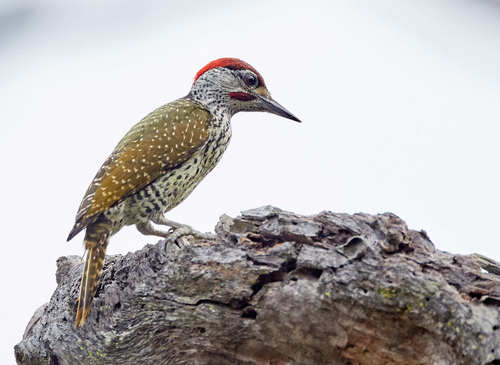
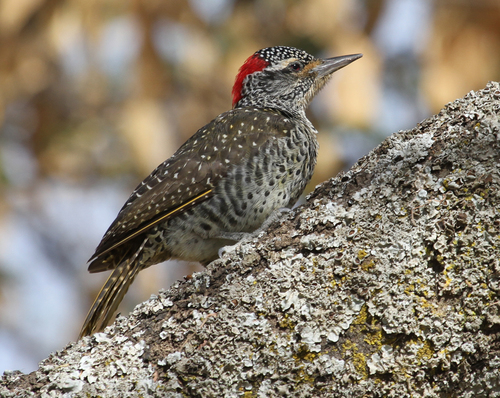
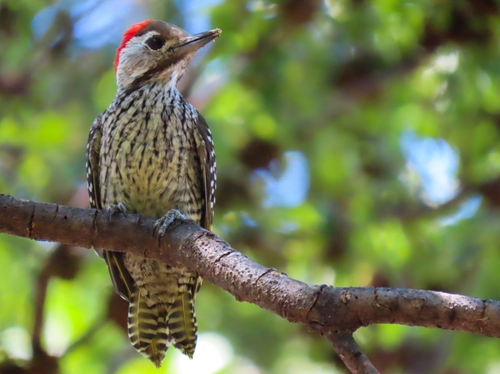
Like other woodpeckers, Dendropicos fuscescens (the cardinal woodpecker) has a straight, pointed bill, a stiff tail that provides support against tree trunks, and zygodactyl (or "yoked") feet, with two toes pointing forward and two pointing backward. Its long tongue can be darted forward to capture insects. This is a very small woodpecker species, measuring 14 to 15 cm (5.5 to 5.9 in) from the tip of its bill to the tip of its tail, with a body shape that is typical for a woodpecker. Its back plumage is dull olive in color, marked with paler dots and bands. The underparts are white, heavily streaked with black, and the rump plumage is tawny. The white throat and face are separated by a conspicuous black malar stripe, and the fore crown is olive brown. As with other woodpeckers, the head pattern varies with the bird's age and sex. Males have a red hind crown and nape; females have a dark hind crown and black nape. Juvenile males have a red hind crown and black nape. The small crest is raised when the bird is excited. The cardinal woodpecker is native to tropical regions of western and central Africa. Its range includes Angola, Benin, Botswana, Burkina Faso, Burundi, Cameroon, Central African Republic, Chad, Congo, Democratic Republic of Congo, Djibouti, Eritrea, Eswatini, Ethiopia, Gabon, Gambia, Ghana, Guinea, Guinea-Bissau, Ivory Coast, Kenya, Lesotho, Malawi, Mali, Mauritania, Mozambique, Namibia, Nigeria, Rwanda, Senegal, Sierra Leone, Somalia, South Africa, South Sudan, Sudan, Tanzania, Togo, Uganda, Zambia and Zimbabwe. It can be found in a wide variety of habitats, from dense forest to thorn bush. The cardinal woodpecker often occurs in small family groups, or may join small mixed flocks. It forages mainly in the lower storeys of trees and among shrubs and vines, and also on maize stalks and reeds. It pecks rapidly and probes dense vegetation, clambering along and hanging from small twigs. Like other woodpeckers, this species is an insectivore. It is frequently seen, and regularly drums softly. Its call is a high-pitched krrrek-krrrek-krrrek. It nests in an unlined tree hole, with only wood chippings present as nesting material.