About Dendrophthoe vitellina (F.Muell.) Tiegh.
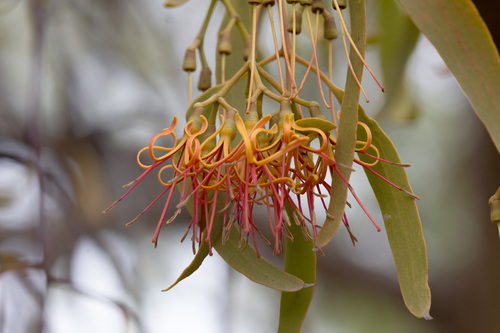
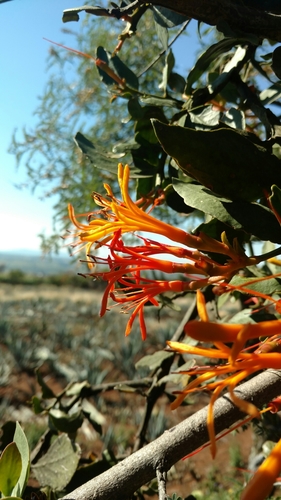
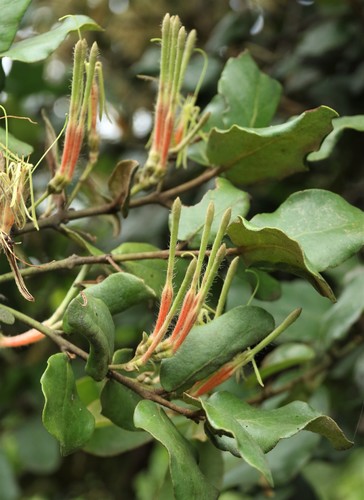
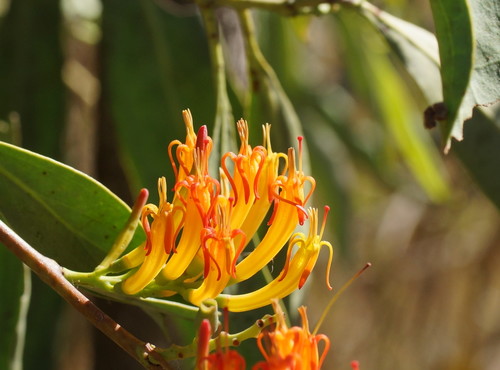
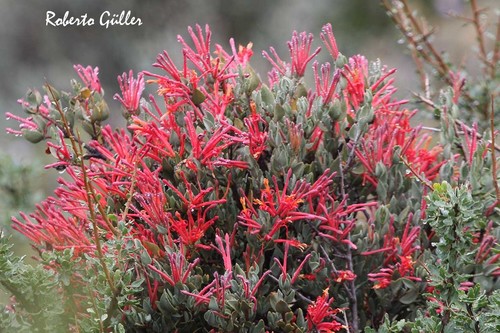
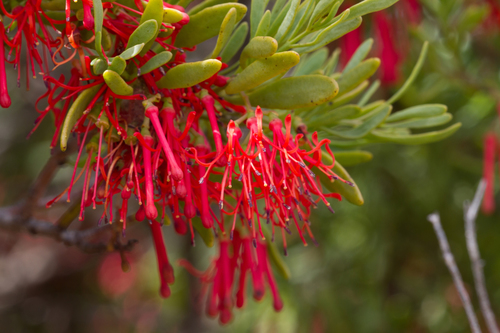
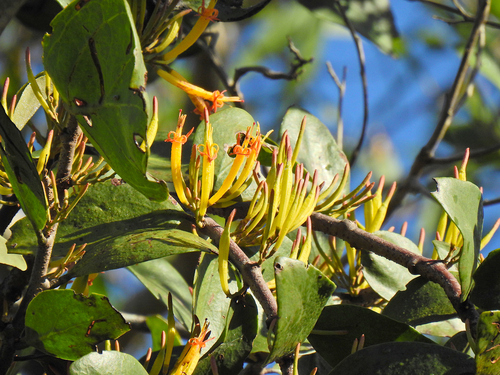
Dendrophthoe vitellina (F.Muell.) Tiegh. grows as a shrubby plant with either a spreading or drooping (pendent) growth habit, growing out from a tree branch or tree trunk. It has external roots; its new growth is hairy, and matures into smooth branches and foliage. Its leaves are either spear-shaped or oval, with a blunt tip, and measure 4 to 16 cm (1.5 to 6.5 inches) long and 0.6 to 3 cm (0.24 to 1.18 inches) wide. Its inflorescences hold between 5 and 20 smaller individual flowers. The flowers are generally yellow or orange with red tips, though some populations in northern regions have redder flowers, and the flowers are covered in fine fur. After flowering, it produces an egg-shaped fruit that is 1 to 1.5 cm (0.39 to 0.59 inches) long, coloured red to yellow, that holds a single seed surrounded by a sticky coating. The closely related similar-looking smooth-flowered mistletoe D. glabrescens has smooth flowers and leaves wider than 3 cm (1 inch), and is found west of the Great Dividing Range. This species ranges from far north Queensland along Australia’s east coast, through New South Wales, and into Victoria. In northern New South Wales, its distribution extends inland to the Nandewar Range. In Victoria, it occurs east of Genoa in East Gippsland. It generally grows on trees in the family Myrtaceae in open sclerophyll forest, and also grows on Eucalyptus grandis in forest located on the edges of rainforest. At least 66 native plant species from 16 families, predominantly the genera Eucalyptus, Angophora and Melaleuca, have been recorded as host plants for Dendrophthoe vitellina; a number of exotic species have also been recorded as hosts, including the exotic plane tree Platanus × hispanica. Growing on a small red bloodwood (Corymbia gummifera) is hazardous for the host tree. Dendrophthoe vitellina is the main host plant for caterpillars of the marbled line blue butterfly (Erysichton palmyra). Caterpillars of many other butterfly species also feed on this plant: the black jezebel (Delias nigrina), red-banded jezebel (Delias mysis), narcissus jewel (Hypochrysops narcissus), silky jewel (Hypochrysops digglesii), dull oakblue (Arhopala centaurus), black-spotted flash (Hypolycaena phorbas), trident pencil-blue (Candalides margarita), dark purple azure (Ogyris abrota), golden azure (Ogyris ianthis), orange-tipped azure (Ogyris iphis), sapphire azure (Ogyris aenone), southern purple azure (Ogyris genoveva) and northern purple azure (Ogyris zosine). The fleshy fruit of this species is eaten by the brushtail possum (Trichosurus vulpecula). After the seed is deposited, it immediately begins germinating, soon penetrates the host tree’s vascular system, and forms a physiological connection with the new host’s xylem. From this connection, the seedling starts obtaining water and mineral nutrients from its host.