About Dendrophthoe falcata (L.fil.) Blume
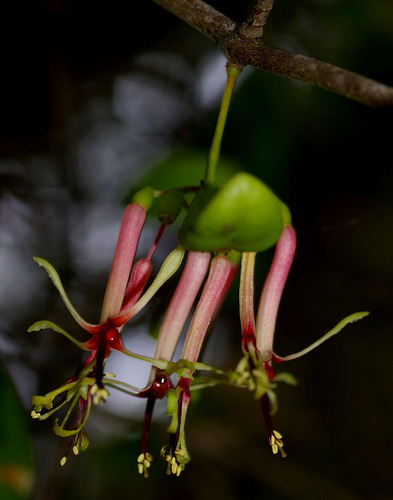
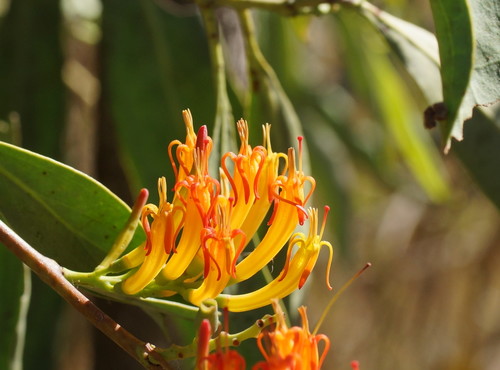
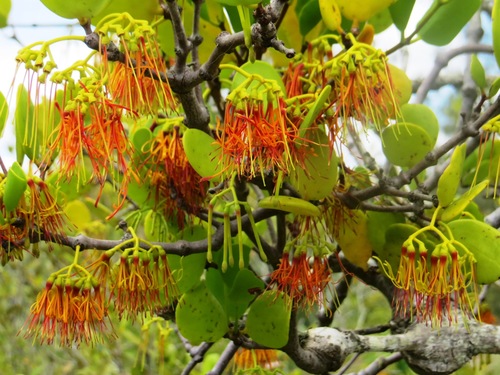
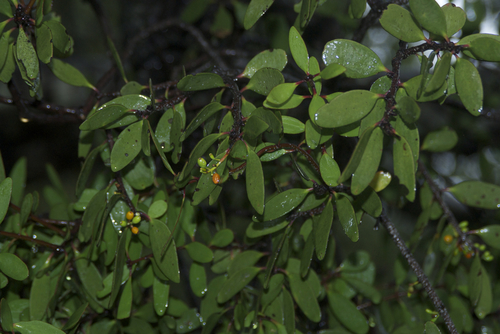
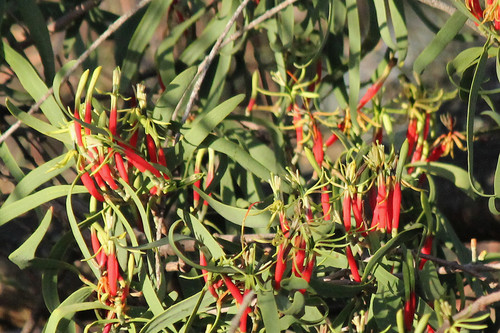
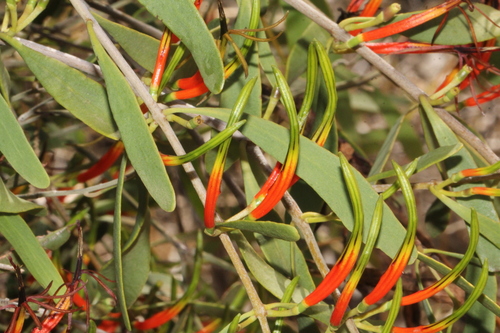
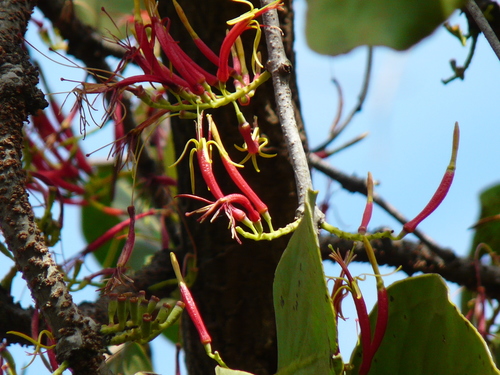
Dendrophthoe falcata (L.fil.) Blume is a hemiparasitic plant in the mistletoe family Loranthaceae. It is the most common mistletoe found in India, and currently has been recorded to infect around 401 different plant host species. The Dendrophthoe genus contains roughly 31 species distributed across tropical Africa, Asia, and Australia (Flora of China, 2003), with 7 of these species native to India. According to Wealth of India (2002), D. falcata has grey bark, thick leathery leaves that vary in shape, and stout flowers. Previously, D. falcata's inflorescence was described as either axillary or growing from the scars left by fallen leaves, but Y.P.S Pundir (1996) determined it is strictly cauliflorous. He also noted that its inflorescence is similar to those of the fig species Ficus glomerata, F. pomifera, and F. hispida. Two varieties of D. falcata are widespread in India: var. falcata (called honeysuckle mistletoe) with white flowers, and var. coccinea (called red honeysuckle mistletoe) with red flowers (Flowers of India). To date, D. falcata holds the distinction of being the mistletoe species with the largest global host range (Calvin and Wilson, 2009), and this range continues to grow rapidly as it incorporates more host species. Pollination and seed dispersal of D. falcata are most often carried out by birds that feed on fruits from either the parasite or its host. In southern India specifically, Tickel's flowerpecker (also known as the pale-billed flowerpecker) is reported to help disperse D. falcata seeds between neem trees through its feces or regurgitation (Karunaichamy et al., 1999; Hambali, 1977 and references therein). Studies conducted at higher altitudes in the Western Ghats, a mountain range running parallel to India's western coast where both mistletoes and flowerpeckers are predominantly found, suggest that flowerpecker-pollinated mistletoes have evolved specialized traits to attract this single vector for both pollination and seed dispersal: their fruits and flowers look similar, and most notably, their fruiting period overlaps with the next flowering season (Davidar, 1983). Hair-crested drongos (also called spangled drongos) and sunbirds are also known to feed on nectar from D. falcata flowers, adding them to the list of this mistletoe's pollinators (Kunwar et al., 2005). Dendrophthoe falcata is used as a traditional medicine across South and Central Asia. It has notable potential as a medicinal plant, with ethanolic extracts of the species documented to have wound healing, antimicrobial, antioxidant, and antinociceptive properties (Pattanayak and Sunita, 2008; Shihab et al., 2006). The medicinal effects of this hemiparasite can vary depending on which host species it grows on (Mallavadhani et al., 2006). In indigenous medicine systems, the whole plant is classified as cooling, bitter, astringent, aphrodisiac, narcotic, and diuretic (Alekutty et al., 1993). It is used to treat pulmonary tuberculosis, asthma, menstrual disorders, swollen wounds, ulcers, renal and vesical calculi, and vitiated kapha and pitta conditions (Anarthe et al., 2008; Sastry, 1952; Pattanayak et al., 2008). A plant decoction used by women as an anti-fertility agent has been documented to have anticancer activity (Nadkarni, 1993). Ethanolic leaf extract of D. falcata significantly and dose-dependently reduces acetic acid-induced writhing in mice (Shihab et al., 2006), and showed low toxicity in brine shrimp lethality assays. A later study by Pattanayak et al. (2008) found that D. falcata hydroalcoholic extract caused significant tumor reduction in induced mammary carcinogenesis in female Wistar rats.