About Dendronanthus indicus (Gmelin, 1789)
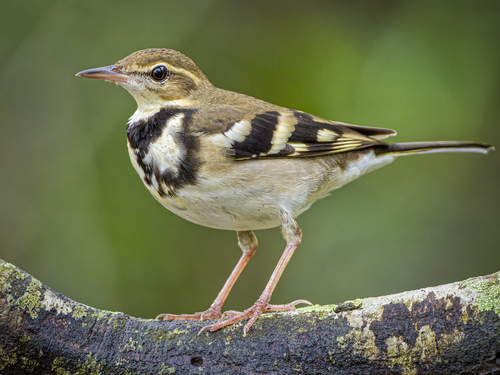
Description: The forest wagtail (Dendronanthus indicus) is a distinctive wagtail species, and it is the only member of the genus Dendronanthus, while all other wagtails are classified in the genus Motacilla. This is a slender bird with a long tail, reaching 18 cm (7.1 in) in length. Its back and crown are olive brown. Its wings are black, marked with two yellow wing bars and white edges on the tertial feathers. It has a white supercilium, positioned above a dark stripe that runs through the eye. Its underparts are white, with the exception of a double black breast band: the upper breast band is shaped like a bib, while the lower breast band is often broken. Males and females have similar plumage. Juvenile birds have more yellowish coloring on their underparts. The forest wagtail produces a frequent single-note call described as 'pink pink', which it gives while on the ground and even during high flight. It also has a soft, lilting song. The subspecies Lanius cristatus confusus of the brown shrike sometimes mimics the forest wagtail's call. Distribution and habitat: As both its English common name and scientific name suggest, the forest wagtail is a forest species, a trait that sets it apart from all other wagtails. It is typically found in open woodland areas such as clearings. During the winter, it occurs mainly in heavily shaded forest habitats, or along paths in coffee plantations and forest clearings. Its breeding range covers eastern Asia, including parts of Korea, parts of China (specifically Gansu, Anhui, and Hunan), and parts of Siberia. Claims of breeding in southern Assam have been questioned. It is migratory, traveling to warmer regions of Asia for the winter. It has been suggested that the species reaches southern India and Sri Lanka by way of the Andaman Islands. It has been recorded as a vagrant in the Maldives and Australia. Previously, researchers believed it only wintered in southwestern India, passing through the rest of the Indian peninsula during migration. Current evidence confirms that it winters across the entire southern portion of the Indian peninsula, in addition to southwestern India. Behaviour and ecology: Forest wagtails occur either singly or in small groups. They often forage in trees, capturing insects along tree branches. They may also forage on the ground in the manner of a pipit; when disturbed, they fly up into trees while giving a sharp 'pink' call. They can climb steep branches and will run rapidly along horizontal branches. They roost alongside other wagtail species among reeds.