About Dendrolycopodium obscurum (L.) A.Haines
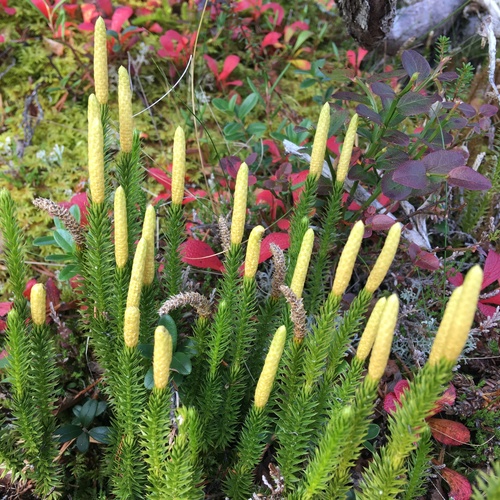
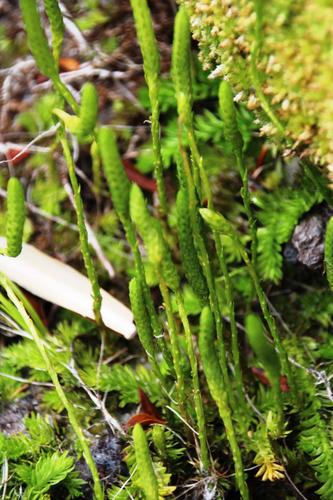
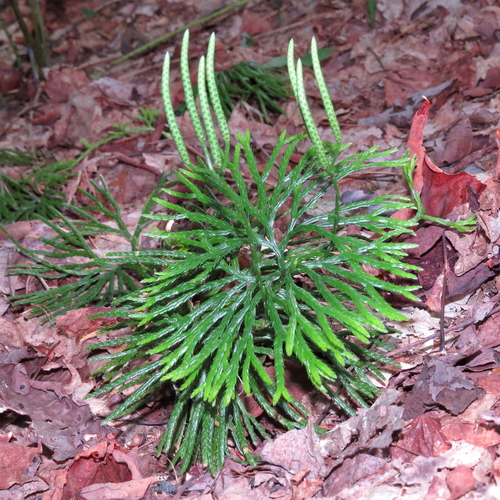
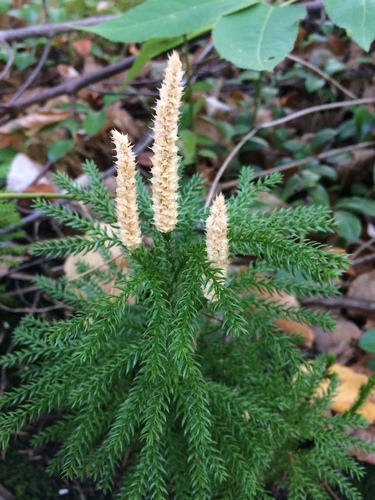
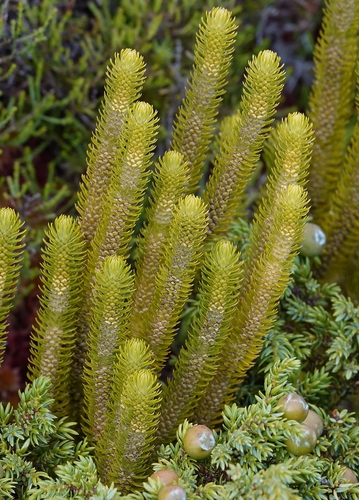
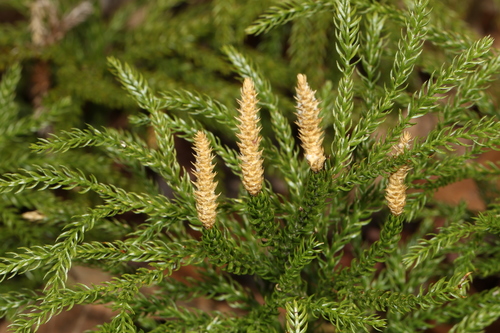
Dendrolycopodium obscurum (L.) A.Haines gets its common appearance from the fact that its sporophyte looks superficially similar to various conifers. Despite this resemblance, its above-ground parts rarely grow taller than 15 cm (6 inches). Its main structural stem is not above ground – instead, it is a creeping subterranean rhizome that grows roughly 6 cm (2.4 inches) below the soil surface. Several aerial shoots branch off from this rhizome, and these shoots also branch dichotomously multiple times, creating the species' distinctive look. Fertile shoots produce sessile strobili, which grow at the tops of the shoots' main axes, and sometimes at the tips of dominant lateral branches. All leaves of this species are microphylls: each leaf holds only a single vein, and measures less than 1 cm (0.4 inches) long. D. obscurum forms two distinct types of microphylls. Green trophophylls cover most of its aerial shoots, while yellow to tan sporophylls make up the strobili and contain the sporangia. This species reproduces both sexually through spores and vegetatively through its underground rhizome. The gametophyte of D. obscurum is a disc-shaped prothallus with an average diameter of 1.5 cm (0.6 inches). It looks very similar to the gametophytes of Lycopodium and related genera, so it cannot be identified by looking at the gametophyte alone. Identifying gametophytes is also made difficult by their growth habit: this type of gametophyte only grows underground, and only years after a disturbance occurs. Compacted soil from repeated human foot traffic disturbs these underground growing areas, which can prevent D. obscurum spores from germinating and damage or kill existing gametophytes. Identifying D. obscurum in the wild can be challenging without prior study, both because the species is relatively rare and because it shares a great deal of its morphology with Dendrolycopodium dendroideum and Dendrolycopodium hickeyi. It can be identified with the naked eye by observing its leaf arrangement. Below the first branch of D. obscurum, microphylls are tightly packed against the stem axis, while the microphylls of D. dendroideum are fully spread all the way down to the soil line. On lateral branches, the leaves of D. dendroideum and D. hickeyi are evenly shaped and evenly distributed. In contrast, the leaves of D. obscurum are pressed into a horizontal plane, and the leaves on the underside of the branch are much shorter than all other leaves on the branch. Historically, Dendrolycopodium obscurum has been harvested from the wild. Harvested shoots were used as Christmas greens to make wreaths, and the species' spores were used to make flash powder. Flash powder is now practically obsolete, but the historical harvest of D. obscurum has led to the species becoming threatened in several regions. As a result, the U.S. states of Indiana and New York have granted D. obscurum legal protection under state law. For legal harvesting of this species, recommended practices include cutting aerial shoots with shears to minimize damage to the underground rhizome, alternating harvest sites each year, and only harvesting individuals that have strobili with open sporophylls. These practices ensure that immature shoots are not harvested, leaving them to mature and complete reproduction.