About Dendrolycopodium hickeyi (W.H.Wagner, Beitel & R.C.Moran) A.Haines
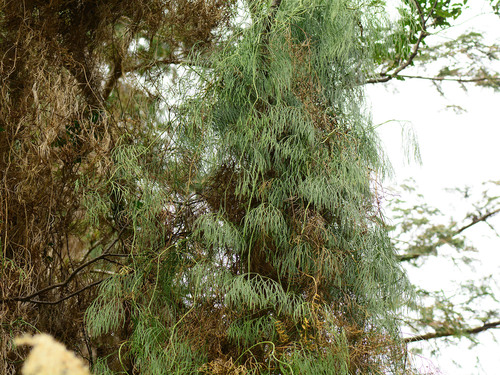
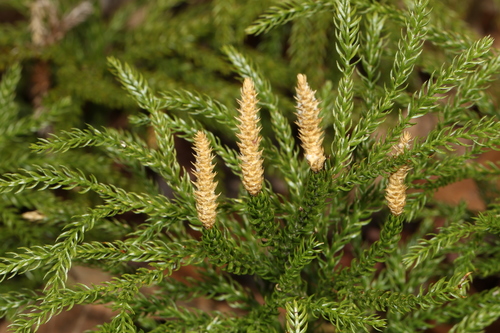
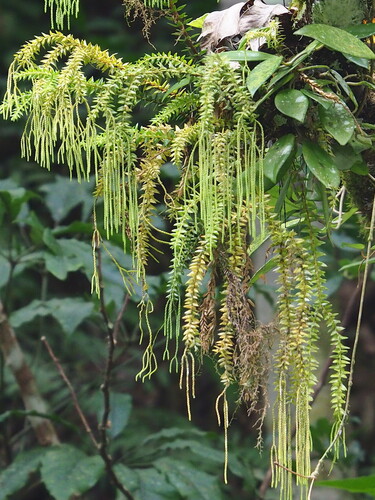
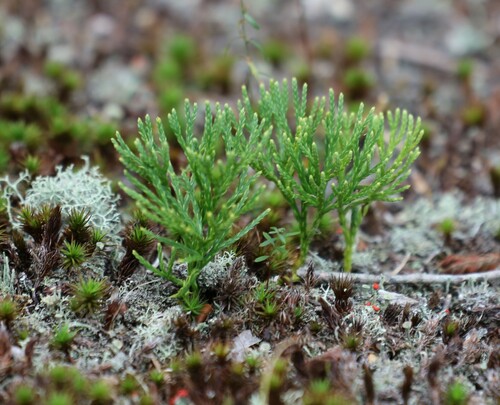
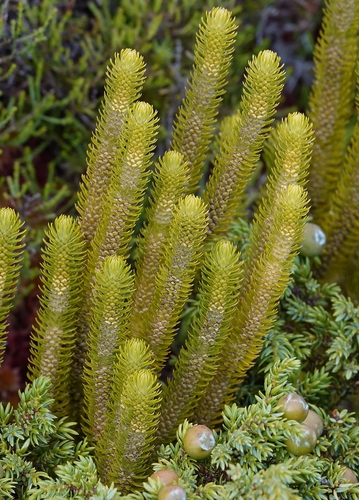
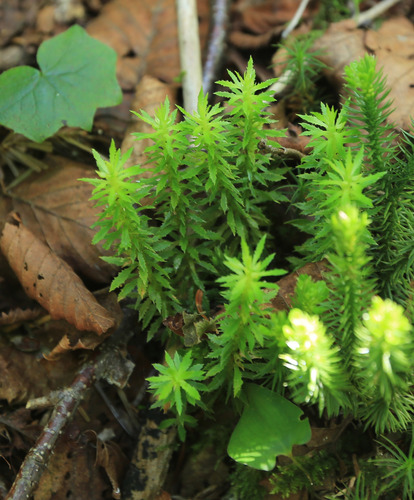
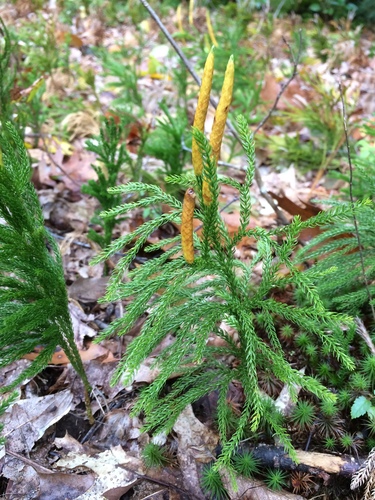
Dendrolycopodium hickeyi is similar to other members of its genus. Its sporophyte resembles the seedlings of some conifers. Upright sporophytes grow from underground horizontal stems, which often causes these tree club-mosses to grow in clusters. The upright sporophytes have small, green microphylls, also called leaves, that extend from the ground all the way to the tips of their branches; the branches themselves are 4–7mm in diameter. These plants stay green throughout the winter. In their final growth year, they typically produce a single, unstalked sessile terminal strobilus that releases spores. Dendrolycopodium hickeyi is outwardly very similar to Dendrolycopodium obscurum, and the two species share overlapping ranges. D. obscurum has reduced leaves on the underside of its branches, while D. hickeyi has leaves of equal length all around its branches – a feature reflected in its former name, Lycopodium obscurum var. isophyllum, where iso means "equal" and -phyllum means "leaf". D. hickeyi can be told apart from D. dendroideum, which also has equal-length leaves around its branches, by the orientation of these leaves. Both D. hickeyi and D. obscurum have a single rank of leaves on the top of their branches, while D. dendroideum has two ranks of leaves on the top of each branch. Additionally, D. hickeyi has leaves that are appressed to the stem below the first branches, unlike the spreading leaves found on D. dendroideum. The strobilus of D. hickeyi is also intermediate in length between the strobili of D. obscurum and D. dendroideum. D. hickeyi is native to the northeastern United States and Eastern Canada. Its range overlaps with several other lycophytes, including D. obscurum and D. dendroideum, which were previously classified as varieties of one another. This species grows in dry or mesic conifer forests, as well as forest openings. It prefers sandy soil and shaded light conditions.