About Dendrohyrax arboreus (A.Smith, 1827)
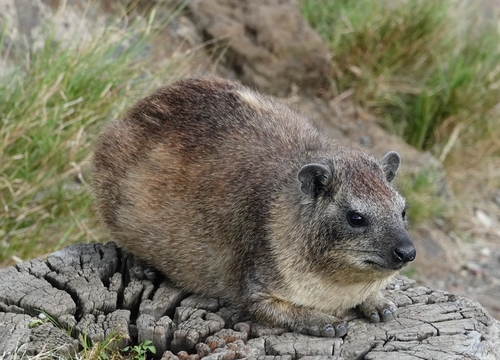
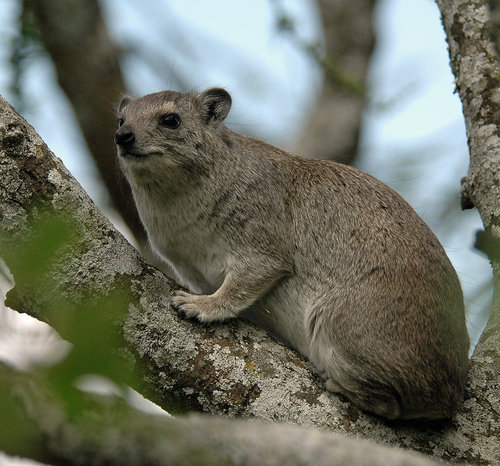
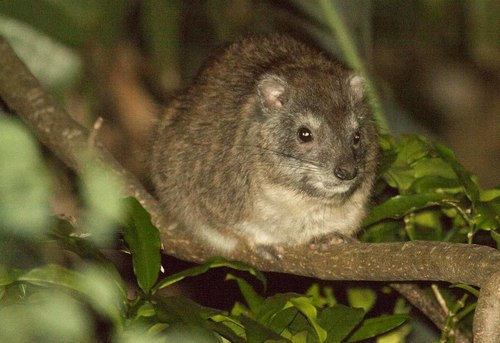
Description: The southern tree hyrax (Dendrohyrax arboreus) has a guinea pig-like appearance. Its body is covered in long, soft, grey-brown fur, with a paler underside. Individual hairs are lighter near their tips, and the edges of its ears have a fringe of white hair. On average, this species weighs around 2.27 kg (5.0 lb), and has an average total length of 52 cm (20 in).
Distribution and habitat: This species occurs in Angola, Zambia, the Democratic Republic of the Congo, Kenya, Uganda, Rwanda, Burundi, Tanzania, Malawi, Mozambique, and South Africa. Its natural habitats include temperate forests, subtropical or tropical dry forests, subtropical or tropical moist lowland forests, subtropical or tropical moist montane forests, moist savanna, and rocky areas. It can be found at elevations as high as 4,500 m (14,800 ft).
Ecology: Predators of the southern tree hyrax include martial eagles, tawny eagles, leopards, lions, jackals, spotted hyenas, and snakes. In Rwanda, feral dogs are the most common predator of this species. The limited time southern tree hyraxes spend on the ground at night may be a strategy to avoid predators. Humans sometimes eat southern tree hyraxes. The related eastern tree hyrax (Dendrohyrax validus) was classified as Near Threatened (NT) in 2015.
Reproduction: Researchers Milner and Harris were unable to definitively determine this species' mating system, but speculated that it may be facultative monogamy or polygyny. After a 7-month gestation period, females give birth to 1 to 2 young. Newborn southern tree hyraxes are well developed, and weigh between 170 and 200 grams (6.0–7.1 oz). When rescued and hand-reared on cow milk formula, they can gain around 4% of their body weight per day, though some young individuals do not thrive on this diet.
Very young southern tree hyraxes have poor coordination. Individuals estimated to be under one week old cannot follow their mothers along branches, but their mobility develops rapidly. By the time they are two weeks old, they will use a shared midden. They feed on a diverse diet of leaves, shoots, bark, fruit, and flowers. Young hyraxes appear to learn which leaves are appropriate to eat by both watching adult hyraxes and tasting the food that adults are chewing. By around five months of age, their fur develops darker spots, which are often located around guard hairs. Southern tree hyraxes reach sexual maturity at approximately 12 months old.