About Dendrodoa grossularia (Van Beneden, 1846)
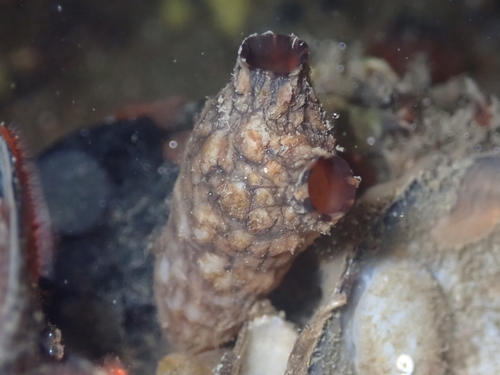
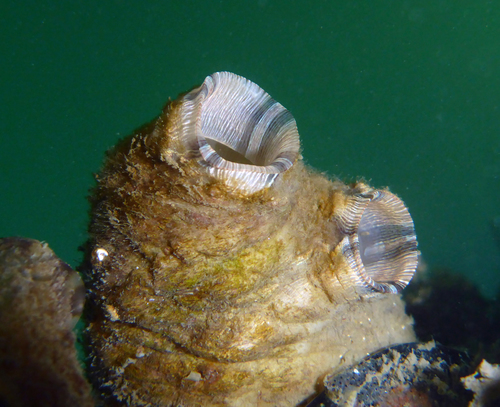
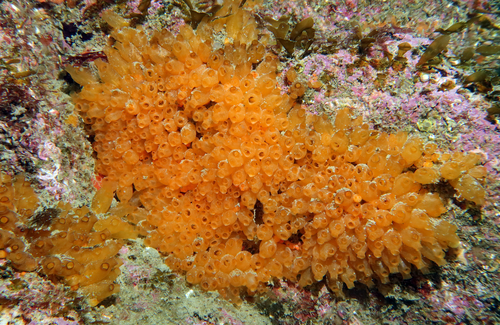
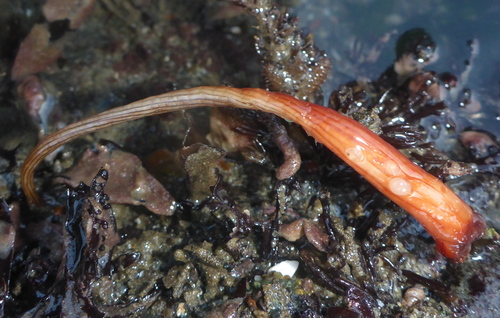
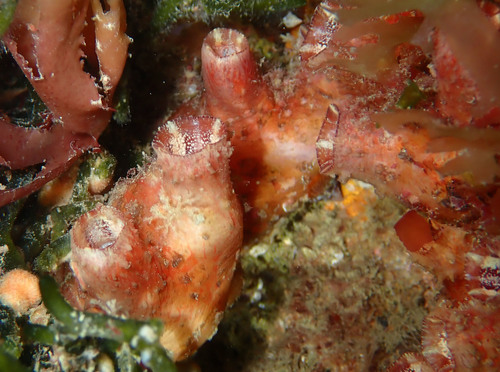
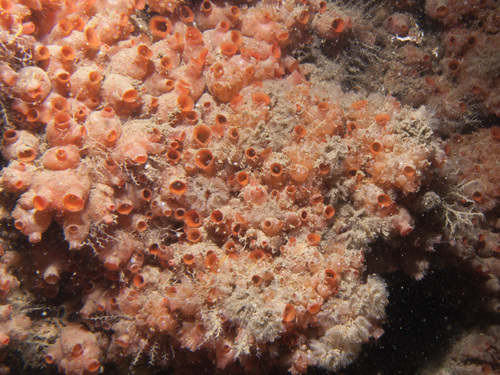
Dendrodoa grossularia is sometimes called the sea currant, named for its small, red, globular shape. It typically grows in aggregations that form mats across rock surfaces, though it occasionally occurs as individual zooids. When crowded together, zooids are cylindrical, growing 20 to 25 mm (0.8 to 1.0 in) tall, with a width half that measurement. Each individual has two circular siphons near its apex; the buccal (inhalent) siphon is slightly larger than the exhalent siphon. Its tunic is smooth, translucent, and fairly firm in consistency, and the siphons are typically a more intense shade of red than the rest of the tunic. Solitary individuals are smaller, flattened, and easily overlooked. Sand or silt is often deposited on the tunic, and the tunic sometimes hosts epibionts. This species can be confused with Distomus variolosus or Stolonica socialis. Distomus variolosus is smaller, never growing more than 10 mm (0.4 in) tall, while Stolonica socialis is a colonial species with a creeping stolon, and is orange or orangish-brown in colour. This species has a wide distribution across the northeastern Atlantic Ocean. Its range includes the Baltic Sea, the English Channel, and northwestern France extending south as far as Quiberon, though it is absent from some localities and occurs in a number of separate sub-populations. Colonies grow on rocks and boulders in areas with strong currents, and sometimes grow on the holdfasts of kelp, at depths from the lower shore down to a few metres. It prefers shaded rocks, boulders, ledges, and overhangs, and can form large populations in suitable habitats. Single zooids may attach to stones or mollusc shells, both living and dead. During exceptionally low tides, it can be found under overhanging rocks on the lower shore. It is tolerant of low salinities, and may occur in estuaries. Like all tunicates, Dendrodoa grossularia is a filter feeder. It draws water in through the buccal siphon and expels it through the exhalent siphon. It is a non-simultaneous hermaphrodite. Sperm is released into the water column, then drawn into other individuals to fertilize ova inside the body cavity. Embryos are brooded in the body cavity before being released into the water as tadpole-like larvae. After a short planktonic period, some larvae settle onto the tunics of adult individuals.