About Dendrocygna viduata (Linnaeus, 1766)
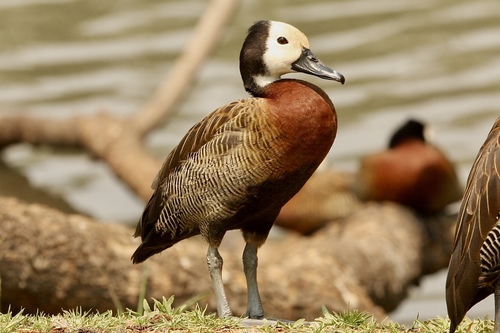
The white-faced whistling duck, scientifically named Dendrocygna viduata (Linnaeus, 1766), has a long grey bill, long head, and moderately long legs. Most of its head and neck are black, with a distinct white patch on the face that gives the species its common name; the extent of visible white facial color varies regionally across the species. As an example of this variation, individuals with more overall black coloration are commonly found in western Africa, where rainfall exceeds the length of the dry season. The species' back and wings range from dark brown to black. Its underparts are black, with fine white barring along the flanks, and the upper neck is chestnut. Males and females have identical plumage patterns. Juveniles share the same coloration as adults, but their head pattern is far less contrasting. This duck has an unusual disjunct distribution, with separate populations found in Africa and South America. Researchers have suggested that humans may have transported these ducks to new locations across the globe. It lives in freshwater lakes or reservoirs with abundant surrounding vegetation, where it feeds on seeds and other plant matter. Due to its large geographic range, the species has many common names, including "irere" and "guiriri". It is an abundant species, and most populations are largely resident, though they make local movements that can cover 100 kilometers or more.