About Dendrocygna javanica (Horsfield, 1821)
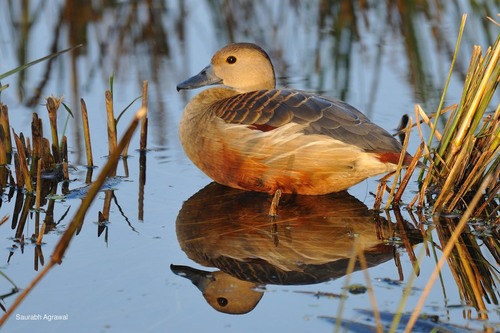
This species, commonly known as the lesser whistling duck, has a scientific name of Dendrocygna javanica (Horsfield, 1821). This chestnut brown duck can only be confused with the fulvous whistling duck (D. bicolor). It differs from fulvous whistling ducks by having chestnut upper-tail coverts, while fulvous whistling ducks have creamy white upper-tail coverts. Dendrocygna javanica has an orange to yellow ring around its eye. When flying straight, individuals hold their head below the level of the body, just like other species in the Dendrocygna genus. The crown appears dark, and males and females have identical plumage. They fly slowly with rapid wing-flapping, and usually produce a repetitive wheezy call as they circle overhead. They are strongly nocturnal, and often rest during the day. The inner vane of their outermost primary feather is modified, and they produce a very prominent whistling sound while flying. This is a largely resident species that is widely distributed across lowland wetlands of the Indian subcontinent and Southeast Asia. The species also occurs on islands within this region, including the Andamans, Nicobars and Maldives. Individuals sometimes make local movements in response to weather and changes in water availability, and birds from more northern parts of the range winter further south. They inhabit freshwater wetlands with good vegetation cover, and often rest during the day on banks, or even on the open sea in coastal areas. Downy chicks are black with a white eyebrow, and white patches on the back of the head, wing, lower back and rump. Albino individuals have been recorded in the wild. Large numbers are sometimes found in urban wetlands such as those in Kolkata and Goa, particularly during winter. Captive individuals were introduced to Alipore Zoological Gardens in the 1930s, and wild birds later joined this introduced population. The species has a wide distribution range between 1 and 10 million km², and is considered to have a secure global population of between two and twenty million individuals. They are not threatened by hunting, as they are not considered good to eat. However, hunters in Assam have been recorded raising ducklings to use as live decoys. Lesser whistling ducks are usually gregarious. They feed mainly on water plants and grains from cultivated rice, and also eat small fish, frogs, and invertebrates such as molluscs and worms. They feed by both dabbling and diving in water. They will often waddle on land, and Common mynas have been observed following them on grass. Courtship behaviour involves the male facing the female, repeatedly dipping and raising its bill in the water, and swimming around the female. They breed during the monsoon or rainy season, and breeding timing may vary locally based on food availability. Nest sites may be tree holes lined with twigs and grass, or nests built in the fork of a large tree. They sometimes reuse old nests built by kites or herons, and may even nest on the ground. Clutch sizes usually range from 7 to 12 white eggs, which are incubated by both parents. Clutches as large as 17 eggs have been recorded, though these are likely the result of intraspecific brood parasitism. The eggs hatch after about 22 to 24 days of incubation. More than one brood may be raised in a single breeding season. Adult parents sometimes carry young birds on their back. Local names for the species in India, such as sili and silhahi, are based on its wheezy two-note calls. They become very tame in captivity, walking around freely and responding to whistles. Captive individuals in the USA have lived for up to 9 years. Several endoparasitic cestodes, including Hymenolepis javanensis and Cittotaenia sandgroundi, have been described from lesser whistling duck hosts, in addition to ectoparasitic bird lice and mites.