About Dendrocygna autumnalis (Linnaeus, 1758)
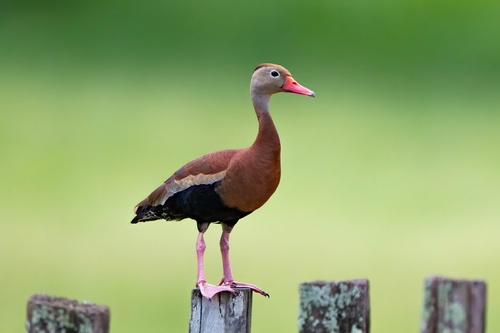
The black-bellied whistling duck (scientific name Dendrocygna autumnalis (Linnaeus, 1758)) is a mid-sized waterfowl species. It measures 47 to 56 cm (19 to 22 in) in length, weighs 652 to 1,020 g (1.437 to 2.249 lb), and has a wingspan of 76 to 94 cm (30 to 37 in). This species has a long pink bill, long head, and moderately long legs. Its head is pale gray, and most of its plumage is gray-brown, with a black belly and black tail. The body plumage, back of the neck, and cap are a rich chestnut brown, while the face and upper neck are gray, with a thin but distinct white eye-ring. In flight, extensive white coloring on the wings is obvious; this white is less visible when the bird is on the ground. The white coloring comes from the secondary remiges, while the primary flight feathers are black, and the wing coverts are brown. Males and females have identical plumage; juvenile birds are similar to adults but have a gray bill and a belly with less contrast between colors. The wing bar of this species is unique among whistling ducks. When the bird is on the ground, it can be hard to make out the light flanks that many individuals have. The fulvous whistling duck (D. bicolor) is the only sympatric whistling duck that has a similar whitish flank stripe. It differs from the black-bellied whistling duck by having dark wings and a lighter belly, the reverse of the black-bellied’s pattern. Juvenile black-bellied whistling ducks are very similar to young white-faced whistling ducks (D. viduata). Young white-faced whistling ducks have a darker bill, no white wing patch, and never show visible white along the sides even when sitting, because their thin white vertical barring on black flanks is very indistinct. As the common name suggests, black-bellied whistling ducks are noisy birds, with a clear whistling waa-chooo call. This species is widely distributed across the American continent. In the north, its range covers the southern United States (including Texas, Arizona, and Louisiana) and Mexico (mainly along the Pacific and Atlantic slopes, the Yucatan Peninsula, southern Mexico, and Baja California). Its range extends through Central America into South America, including Venezuela, Colombia, Ecuador, and Peru. The black-bellied whistling duck is generally not strongly migratory, although it is listed on the List of Birds protected by the United States Migratory Bird Treaty Act (MBTA). Within the core of its range, flocks tend to travel during the winter months, but this movement is not true long-range migration, only local dispersal. In the 21st century, small numbers of black-bellied whistling ducks have been observed nesting in the Midwestern United States, including Ohio, Missouri, Illinois, Indiana, and Wisconsin. The species has also been recorded as a stray in the eastern United States and Canada. Black-bellied whistling ducks are a common species described as "quite tame, even in the wild". They are highly gregarious (social), forming large flocks when not breeding, and are largely resident aside from local movements. They usually nest in hollow trees; in South America, they often nest in palm trees. Their typical habitat is shallow freshwater ponds, lakes, marshes, cultivated land, or reservoirs with plentiful vegetation. In this habitat, they feed mainly at night on seeds and other plant food. Feeding is most often nocturnal, but black-bellied whistling ducks can be found feeding at any time of day. They eat a wide variety of plant material, including corn, rice, millets, several types of weeds, and other grasses. They also consume arthropods such as insects and spiders, aquatic invertebrates such as snails and other mollusks, and tadpoles when these foods are available. They often feed on submerged vegetation by wading through shallow water. As the Latin species name autumnalis implies, they are commonly seen foraging in recently harvested fields to collect leftover seeds and the invertebrates that are exposed when harvesters disturb the soil.