About Dendrocygna arborea (Linnaeus, 1758)
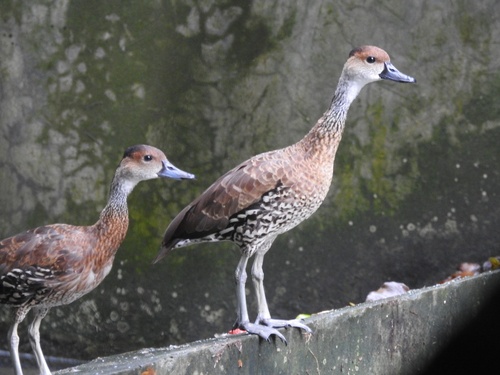
The West Indian whistling duck, with the scientific name Dendrocygna arborea (Linnaeus, 1758), is the largest and darkest species of whistling duck. It measures 48 to 58 cm (19 to 23 in) in length. Females weigh between 800 and 1,320 g (1.76 to 2.91 lb), while males weigh between 760 and 1,240 g (1.68 to 2.73 lb). This species is roughly the same size as a mallard. It has a long black bill, a long head, and moderately long legs. Its face is light brown, and its foreneck is pale. The crown, back, breast, and wings range from dark brown to black. The rest of its underparts are white with prominent heavy black markings. All adult plumages of this species look similar; only juvenile birds are duller in color and have a belly pattern with less contrast. This duck is widely scattered across the West Indies. It has a large breeding population in the Bahamas, and smaller populations are found in Cuba, the Cayman Islands, Antigua and Barbuda, Jamaica, Hispaniola (which includes both the Dominican Republic and Haiti), and Puerto Rico. The species is largely sedentary, only making local movements that can cover 100 km or more. West Indian whistling ducks are mostly nocturnal and secretive. They inhabit wooded swamps and mangroves, where they roost and feed on plant food, including the fruit of the royal palm.