About Dendrocoptes medius (Linnaeus, 1758)
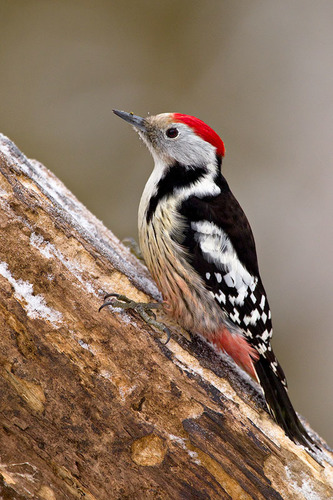
The middle spotted woodpecker, Dendrocoptes medius, is 20–22 cm in total length, with plumage that resembles the great spotted woodpecker. Like the great spotted woodpecker, its upperparts are mostly black, with white oval patches and white barring on the wings, while its underparts are white. The key differences between the two species are that the middle spotted woodpecker has a red crown, no black moustachial stripe, a pink vent, and dark streaks on its flanks. Although only slightly smaller than the great spotted woodpecker, it looks smaller because of its short, slender bill and more rounded, pale head. It can also be confused with the Syrian woodpecker, especially juvenile Syrian woodpeckers; it can be distinguished from the Syrian woodpecker by its smaller bill, its red crown lacking narrow black sides, and its moustachial stripe not reaching the bill. This species is found only in Europe and parts of West Asia within the Palearctic. Its range extends from northern Spain and France east to Poland and Ukraine, and south to locally present central Italy, the Balkan Peninsula, Lithuania, Latvia, Turkey, the Caucasus, and Iran. It is common in Estonia, but almost completely absent from Finland. It used to breed in Sweden before going extinct there in the 1980s, but middle spotted woodpeckers have been seen again in their breeding habitat in Sweden in recent years, indicating the country is being recolonized. Because the species is sedentary, it has never been recorded in the British Isles. It prefers deciduous forest areas, particularly those with old oak, hornbeam and elm, and a mix of clearings, pasture and dense woodland. In terms of behaviour, this woodpecker prefers to feed high in trees, moving constantly which makes it difficult to get a clear view of the bird. During the breeding season, it excavates a nest hole around 5 cm wide into a decaying tree trunk or thick branch. It lays four to seven eggs, and incubation lasts 11–14 days. Its diet consists mainly of insects and their larvae, which it picks from branches and twigs rather than hacking them out from under bark. It will also feed on tree sap. It is rarely heard drumming, and never drums for territorial purposes; it asserts territory through song, a slow, nasal sequence of gvayk notes. Its other calls include a fast kik kekekekek.