About Dendrocopos major (Linnaeus, 1758)
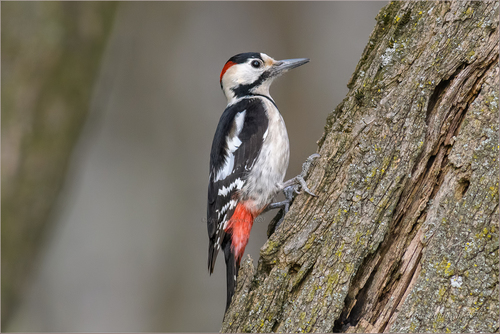
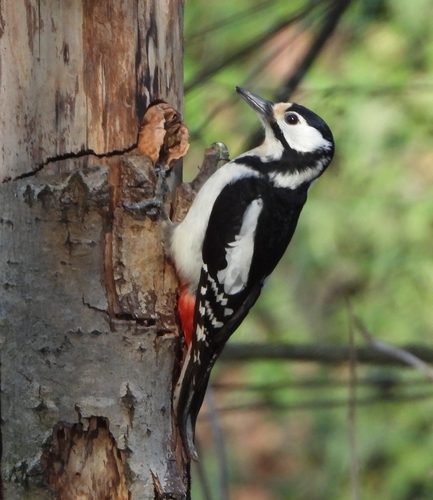
Adult great spotted woodpeckers (Dendrocopos major) measure 20–24 cm (7.9–9.4 in) in length, weigh 70–98 g (2.5–3.5 oz), and have a wingspan of 34–39 cm (13–15 in). Their upperparts are glossy blue-black, with white coloring on the sides of the face and neck. Black lines extend from the shoulder to the nape, the base of the bill, and roughly halfway across the breast. They have a large white shoulder patch; their flight feathers and tail are barred black and white. Their underparts are white, except for a scarlet lower belly and undertail. The bill is slate-black, the legs are greenish-grey, and the eye is deep red. Males have a crimson patch on the nape, which is not present in the otherwise similar females. Juvenile birds are less glossy than adults, have a brown tinge to their upperparts and dirty white underparts. Their markings are less defined than adults, and their lower belly is pink rather than red. The juvenile crown is red, with less extensive red in young females than young males. Different subspecies vary in plumage, following the general pattern predicted by Bergmann's rule: northern forms are larger, have heavier bills, and are whiter on the underparts. For example, north Eurasian D. m. major and D. m. kamtschaticus are large and distinctly white, while D. m. hispanicus from Iberia and D. m. harterti from Corsica and Sardinia are smaller and have darker underparts. D. m. canariensis and D. m. thanneri from the Canary Islands are similar to the Iberian subspecies but have contrasting white flanks. In Morocco, D. m. mauritanus is pale on the underparts with red in the center of its breast, and birds breeding at higher altitudes are larger and darker than those at lower elevations. D. m. numidus from Algeria and Tunisia is very distinctive, with a breast band made of black feathers tipped with red. Caspian D. m. poelzami is small, has a relatively long bill, and has brown underparts. D. m. japonicus from Japan has less white on the shoulders but more white in the wings. The two Chinese subspecies, D. m. cabanisi and D. m. stresemanni, have brownish heads and underparts, and often have some red on the breast. Both subspecies have increasingly dark underparts further south across their ranges. Several other species in the Dendrocopos genus are similar to the great spotted woodpecker. The Syrian woodpecker lacks the great spotted woodpecker's black cheek bar, has whiter underparts and paler red lower underparts; however, juvenile great spotted woodpeckers often have an incomplete cheek bar, so they can be misidentified as Syrian woodpeckers. The white-winged woodpecker has a much more extensive white wing patch than the great spotted woodpecker. The Sind woodpecker is very similar to the Syrian woodpecker, and can be distinguished from the great spotted woodpecker the same way Syrian woodpeckers can. The great spotted woodpecker ranges across Eurasia from Ireland to Japan, and across North Africa from Morocco to Tunisia; it is only absent from areas that are too cold or too dry to support suitable woodland habitat. It occurs in a wide variety of woodland types, including broadleaf, coniferous, and mixed woodland, as well as modified habitats such as parks, gardens, and olive groves. It is found from sea level up to the tree line, reaching elevations of 2,000 m (6,600 ft) in Europe, 2,200 m (7,200 ft) in Morocco, and 2,500 m (8,200 ft) in Central Asia. This species is mainly resident year-round, but large movements can happen when pine and spruce cone supplies are short in the northern part of its range. Highland populations often move down to lower altitudes during winter. Juveniles also tend to wander some distance from their hatching site, commonly traveling 100–600 km (60–400 mi), and sometimes as far as 3,000 km (1,900 mi). Vagrants have reached the Faroe Islands, Hong Kong, and Iceland, and there are multiple confirmed sightings in North America, at minimum including the Aleutian Islands, Pribilof Islands, and Alaska. Due to deforestation, the great spotted woodpecker was extirpated from Ireland in the seventeenth century, but the island has been naturally recolonized, with the first confirmed nesting recorded in County Down in 2007. Its range expansion continues: by 2013, breeding was confirmed or suspected in at least 10 counties, with the main population concentrated in Down and County Wicklow, and by 2021 it had reached all but Mayo. Genetic evidence shows the Irish population is descended from British rather than Scandinavian birds, with separate origins for the populations in Ireland and Northern Ireland. Great spotted woodpeckers were also found nesting on the Isle of Man from 2009, with regular breeding starting in 2010.