About Dendrocollybia racemosa (Pers.) R.H.Petersen & Redhead
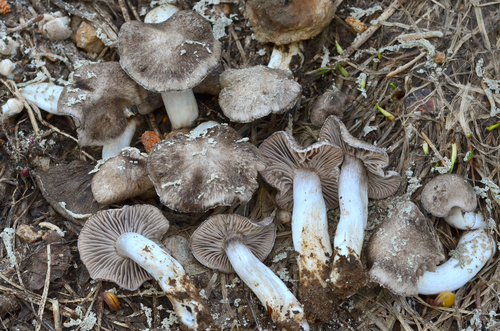
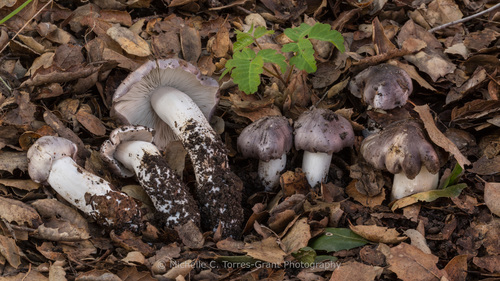
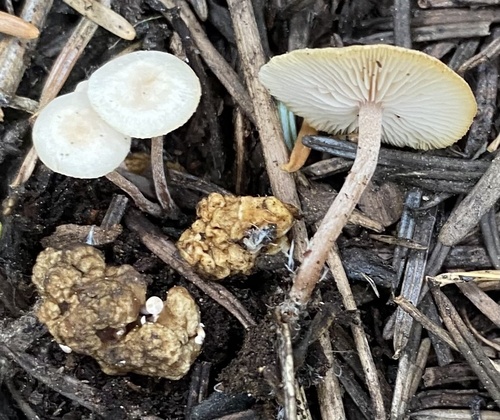
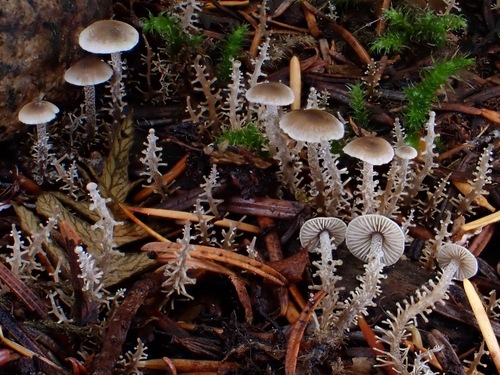
Dendrocollybia racemosa, scientifically named Dendrocollybia racemosa (Pers.) R.H.Petersen & Redhead, has the following physical characteristics. Its cap typically measures 3 to 10 mm (0.1 to 0.4 in) in diameter. Depending on its development stage, the cap may be conic to convex; when mature, it is somewhat flattened with a slightly rounded central elevation called an umbo. The cap surface is dry, opaque, and has a silky texture. The center of the cap is fuscous, a dusky brownish-gray color, and the color fades evenly toward the margin. Initially, the margin usually curves toward the gills; as the fruit body matures, the edge may uncurl slightly, but it also tends to fray or split with age. Shallow grooves matching the position of the underlying gills may appear on the cap, giving the cap edge a scalloped, or crenate, appearance. The flesh is very thin, less than 1 mm thick, fragile, colorless, and has no distinctive odor or taste. The gills are relatively broad, narrowly attached to the stem (adnexed), and closely spaced. They are colored gray to grayish-tan, which is somewhat darker than the cap. Additional shorter gills called lamellulae, which do not reach the stem, are interspersed between full-length gills and arranged in up to three equal-length tiers. Occasionally, this fungus produces stems with aborted caps, or no cap at all. The stem is 4 to 6 cm (1.6 to 2.4 in) long by 1 mm thick, roughly consistent in width along its length, and tapers to a long "root" that ends in a dull black, roughly spherical sclerotium. The stem may be buried deeply in its substrate. The stem surface is roughly the same color as the cap, with a fine whitish powder on the upper portion. The lower portion of the stem is brownish, with fine lengthwise grooves running along its surface. The lower half is covered with irregularly arranged short branch-like protuberances that grow at right angles to the stem, measuring 2–3 by 0.5 mm. These projections are cylindrical and tapering, with ends covered in a slime head of conidia, asexual fungal spores. D. racemosa is the only mushroom species known to produce conidia on side branches of the stem. The sclerotium that the stem grows from is watery grayish and homogeneous in cross section, meaning it has no divided internal chambers, with a thin dull black outer coat, and measures 3 to 6 mm (0.12 to 0.24 in) in diameter. American mycologist Alexander H. Smith noted that novice collectors typically miss the sclerotium the first time they encounter this species. The edibility of D. racemosa is unknown, but as mycologist David Arora notes, the fruit bodies are "much too puny and rare to be of value". Microscopically, the spores are narrowly ellipsoid to ovoid, thin-walled, hyaline (translucent), and measure 4–5.5 by 2–3 μm. When stained with Melzer's reagent, the spores turn light blue. The basidia (spore-bearing cells) are four-spored, measure 16–20 by 3.5–4 μm, and taper gradually toward the base. Cystidia are not differentiated in this species. The cap surface has a cuticle made of radial, somewhat agglutinated, rather coarse hyphae that differ mainly in size from the underlying tissue: the cuticle hyphae are initially 1–3 μm in diameter, while underlying tissue hyphae grow to 5–7 μm wide. The hyphae have clamp connections, and are encrusted with shallow irregularly shaped masses that are most visible in surface cells. The gill tissue is made of hyphae that extend downward from the cap and arranged in a subparallel pattern, meaning the hyphae are mostly parallel to one another and slightly intertwined. These hyphae have clamp connections, with a narrow, branched compact subhymenium (a narrow layer of small, short hyphae directly beneath the spore-producing hymenium) made of hyphae 2–3 μm in diameter. The conidia measure 8.5–12 by 4–5 μm, are peanut-shaped, non-amyloid (they do not change color when stained with Melzer's reagent), have clamp connections, and are produced by fragmentation of coarse mycelium. Asexual spores measure 10.0–15.5 by 3–4 μm, are ellipsoid to oblong, non-amyloid, and contain granular contents. Clamp connections are present in all hyphae of this species. The grayish color of D. racemosa fruit bodies comes from encrusted pigments, which are crystalline aggregates of pigment molecules, possibly melanin, that occur throughout all tissue of the stem, cap, and gills; these pigments are not present in Collybia species. Dendrocollybia racemosa is a saprobic species, meaning it gets nutrients by breaking down dead or dying organic tissue. Its fruit bodies grow on the well-decayed remains of other agarics, often suspected to be Lactarius or Russula, though host identities are usually unclear due to the advanced state of decay. A 2006 study used molecular analysis to confirm Russula crassotunicata is a host for D. racemosa. This Russula species has a long, persistent decay period, and in the Pacific Northwest region of the United States where the study was conducted, it provides a nearly year-round substrate for mycosaprobic species. Dendrocollybia is one of four agaric genera that are obligately associated with growing on the fruit bodies of other fungi; the other three are Squamanita, Asterophora, and Collybia. Dendrocollybia racemosa is also found less commonly growing in deep coniferous duff, appearing in groups or small clusters. The fungus can form sclerotia in mummified host fruit bodies, and may also develop directly from its sclerotia in soil. This fungus is widely distributed across temperate regions of the Northern Hemisphere, but is rarely collected, probably due to its small size, camouflage color, and tendency to be immersed in its substrate. In North America, its distribution is restricted to the Pacific Northwest, and fruit bodies appear from late summer to autumn, often after the main heavy fruiting period for other mushrooms has ended. In Europe, it is recorded from the United Kingdom, Scandinavia, and Belgium. Dendrocollybia racemosa is included on the Danish, Norwegian, and British Red Lists of threatened fungi. The saprobic behaviors of Collybia and Dendrocollybia differ slightly. In autumn, fruit bodies of C. cirrhata, C. cookei, and C. tuberosa grow on blackened, leathery, mummified fruit bodies of their hosts. Sometimes these species appear to grow from soil, or from their sclerotia in soil or moss, and usually do not form large clusters; in these cases, it is assumed the hosts are remnants of fruit bodies from a previous season. However, in all observed cases of D. racemosa, the host is not readily visible, which suggests D. racemosa may digest its host rapidly instead of mummifying it. Hughes and colleagues suggest this difference may indicate D. racemosa has a different enzymatic system, and different ability to compete with other fungi or bacteria.