About Dendrocnide moroides (Wedd.) Chew
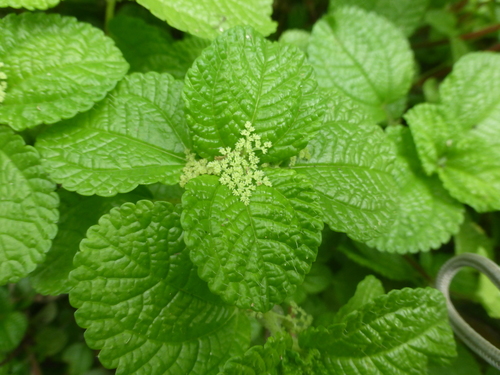
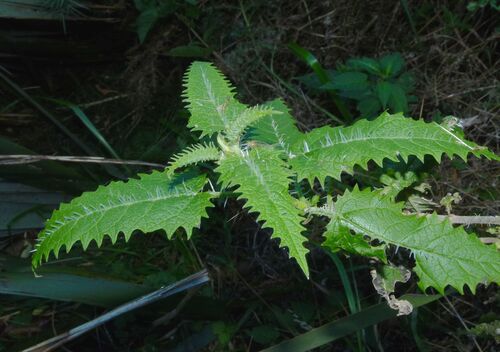
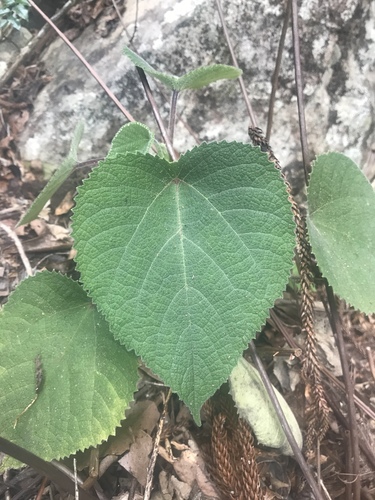
Dendrocnide moroides (Wedd.) Chew is a straggly perennial shrub. It usually flowers and fruits when it is less than 3 m (10 ft) tall, but can reach up to 10 m (33 ft) in height. It is superficially similar to Dendrocnide cordifolia; the most obvious difference is the point where the petiole attaches to the leaf blade. D. moroides has a peltate attachment, meaning the leaf stalk attaches to the underside of the leaf, not at the edge, while D. cordifolia has a cordate attachment. All parts of D. moroides—stem, branches, petioles, leaves, and fruits—are covered in stinging hairs. It produces large, simple, heart-shaped leaves around 12–22 cm (4+1⁄2–8+1⁄2 in) long and 11–18 cm (4+1⁄2–7 in) wide, with toothed margins, a pointed tip, and a base shape that ranges from cordate to obtuse. There are six to eight pairs of lateral veins on each side of the leaf midrib. The petiole (leaf stem) is quite long, roughly as long as the leaf blade itself, and the plant has stipules around 1–2 cm (1⁄2–3⁄4 in) long. Its inflorescence is monoecious, and very rarely dioecious; it grows in the leaf axils, reaches up to 15 cm (6 in) long, and is often paired. It holds both male and female flowers, which are quite small, with the perianth measuring less than 1 mm (0.04 in) across. This species flowers year-round, with the majority of flowering occurring in summer. Its fruit is a tiny, seed-like achene, produced in large numbers within a pink to light-purple globular structure that looks similar to a mulberry. Each achene is just 2 mm (0.08 in) long, and is held in a small fleshy sac that develops from a swollen pedicel. Like all other parts of the plant, the fruiting inflorescences are covered in stinging hairs, but they are edible if the hairs are removed. This species grows in and near rainforest, ranging from Cape York Peninsula south to northern New South Wales in Australia; it also grows in the Moluccas and Indonesia. It is an early colonizing species that grows in rainforest gaps, such as along water courses and roads, around tree falls, and in man-made clearings. Its seeds germinate in full sunlight after soil disturbance. It is common in Queensland, but rare in the southernmost part of its range, and is listed as an endangered species in New South Wales. Dendrocnide moroides acts as a host plant for larvae of the white nymph butterfly. A range of insects feed on its leaves, including the nocturnal beetle Prasyptera mastersi and the moth Prorodes mimica. The herbivorous red-legged pademelon also feeds on its leaves; this mammal is unique in appearing to be immune to the plant's neurotoxins. Various birds eat the plant's fruits and distribute its seeds through their droppings. D. moroides is well known for its extremely painful sting that can leave sufferers experiencing pain for weeks or even months. It is widely considered the most urticant plant in Australia, and possibly the world. After contact with the plant, victims experience an immediate severe burning and stinging at the contact site, which intensifies further over 20 to 30 minutes, and lasts from hours to several days before fading. Pain intensity can prevent victims from sleeping during this period. In severe cases, contact can cause urticaria (hives), and painful swelling of the lymph glands under the arms; there have also been rare cases that require hospitalization.