About Dendrocalamus giganteus Munro
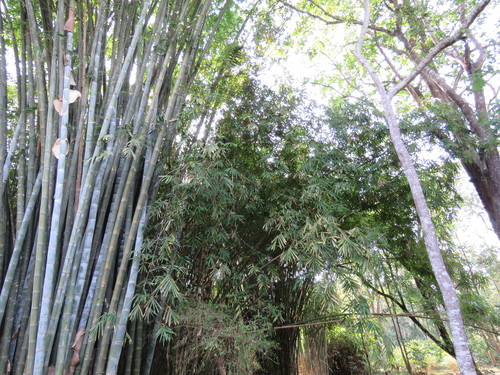
Dendrocalamus giganteus Munro is a very tall bamboo species with large greyish-green culms that grows in dense clumps. It typically reaches 30 m (98 ft) in height, though one recorded clump in Arunachal Pradesh, India grew to 42 m (138 ft). Culms can grow up to 28 cm (11 in) thick; only Dendrocalamus sinicus has thicker or taller culms than this species. Under favourable growing conditions, this bamboo can grow up to 40 cm (16 in) per day. The official recorded maximum daily growth for the species is 46 cm (18 in) over 24 hours, a record set July 29–30, 1903 at Peradeniya Royal Botanical Gardens in Ceylon, now Sri Lanka. Unconfirmed reports note growth reaching up to 1 m (3 ft 3 in) in 24 hours. In subtropical climates, this species grows shorter, typically reaching only 20 m (66 ft) in height. Its culms are straight, with a powdery greyish-green appearance that changes to brownish-green when dried, and have a smooth surface. Young shoots of Dendrocalamus giganteus are blackish purple. Internodes on culms measure 25–40 cm in length, and overall culm diameter ranges from 10–35 cm. Culm walls are thin, rarely growing thicker than 2.5 cm (0.98 in), and branching only occurs at the top of the culm. Aerial roots extend as high as the eighth node, and the rootstock is stout. Young culm sheaths are greenish, turning dark brown when mature. Sheaths are large and broad, with the sheath proper measuring 24–30 cm long and 40–60 cm wide. The sheath blade is triangular and 7–10 cm long. The top of the sheath is rounded, and the auricles are small, equal in size, and crisped. The upper surface of the sheath is covered in stiff gold and brownish hairs, while the under surface is glossy and hairless. Culm sheaths detach from the plant early in development. This species is native to India, Myanmar, Thailand, and Yunnan province in China. It naturally inhabits forests and river banks, growing at altitudes from sea level up to 2,000 metres (6,600 ft). Dendrocalamus giganteus is used for construction and weaving, and its young shoots are edible.