About Dendrobium linguiforme Sw.
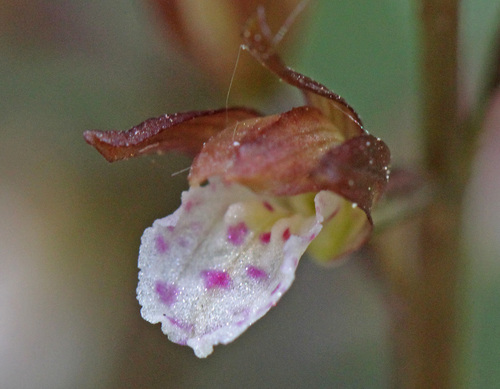
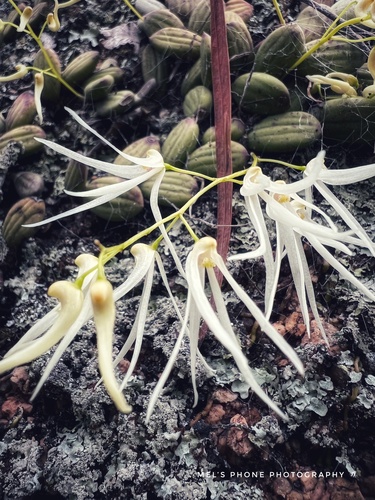
Dendrobium linguiforme Sw. is an epiphytic or lithophytic orchid that grows with prostrate stems, which produce wiry roots along almost their entire length. These roots measure 1–4 cm (0.4–2 in) long and 3–4 mm (0.1–0.2 in) in diameter. Each branch of the stem bears a single leaf at its tip. The leaf is oblong to egg-shaped, 2–4 cm (0.8–2 in) long, 8–15 mm (0.3–0.6 in) wide, and 4–6 mm (0.16–0.24 in) thick. It is succulent, with a smooth upper surface that also has ridges and furrows. Up to twenty flowers grow in a raceme 5–15 cm (2–6 in) long. The dorsal sepal is linear to narrow lance-shaped, 15–22 mm (0.6–0.9 in) long and 3–4 mm (0.12–0.16 in) wide. Lateral sepals are 18–22 mm (0.7–0.9 in) long and 4–5 mm (0.16–0.20 in) wide, while petals are slightly smaller. Both petals and sepals are white to cream-coloured. The labellum is cream-coloured with pale purple markings, and measures 5–6 mm (0.20–0.24 in) long and 3–4 mm (0.12–0.16 in) wide. Flowering takes place in September and October.
This species, commonly called the tongue orchid, is distributed in New South Wales and Queensland, where it grows on rocks and trees. It most commonly inhabits sclerophyll forest, and may also grow in rainforest or rocky areas. In New South Wales, it occurs on the coast and tablelands north of Ulladulla, and extends inland as far as Gungal and Tamworth. In Queensland, it is found from the Atherton Tableland to Townsville, and from Gympie south to the border with New South Wales.