About Dendrobium crumenatum Sw.
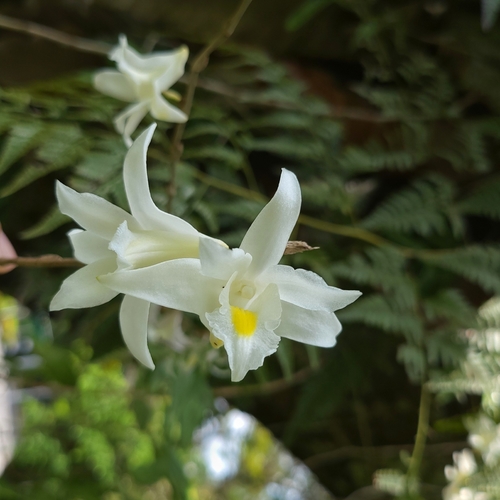
Dendrobium crumenatum Sw., commonly called the pigeon orchid, produces upright, sympodial pseudobulbs that measure 300–700 mm (10–30 in) long and 8–12 mm (0.31–0.47 in) wide. These pseudobulbs are swollen at the first three or four lower nodes. The middle portion of each pseudobulb holds two rows of leathery, oblong to egg-shaped leaves that are 50–80 mm (2–3 in) long and 10–20 mm (0.39–0.79 in) wide. The top portion of the pseudobulb bears pure white flowers that are 30–40 mm (1–2 in) long and wide. The dorsal sepal and petals measure 15–18 mm (0.6–0.7 in) long and 5–7 mm (0.2–0.3 in) wide, while the lateral sepals are slightly longer and wider. The labellum is 20–24 mm (0.8–0.9 in) long and 13–15 mm (0.5–0.6 in) wide, with three lobes: the side lobes are erect, and the rounded middle lobe has five yellow ridges. Flowering of this species is sporadic, but it is triggered nine days after a sudden drop in temperature of at least 5.5 °C. This temperature drop usually occurs due to rain, though the same effect can be created artificially. The flowers are fragrant, but their scent only lasts for one day. Joseph Arditti describes the species' flowering as "gregarious": all flower buds in a given geographic area bloom on the same exact day, for exactly one day, with no buds blooming early or late. In its native range, the pigeon orchid usually grows in exposed locations, most often in lowland rainforest or coastal scrub. It is naturally found in India, Indochina, Taiwan, the Philippines, Singapore, Malaysia, Indonesia, New Guinea, and Christmas Island. It is reportedly naturalized in Fiji, Hawaii, the West Indies and the Seychelles.