About Dendrobium bigibbum Lindl.
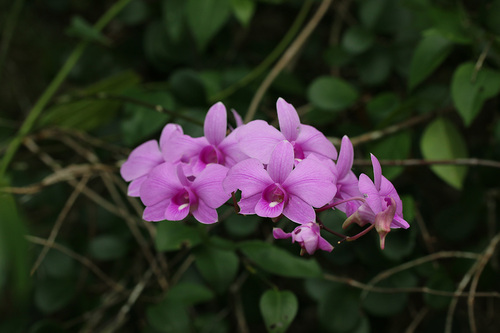
Dendrobium bigibbum is an epiphytic or lithophytic orchid. It produces green or purplish pseudobulbs that measure 200–1,200 mm (8–50 in) long and 15–20 mm (0.6–0.8 in) wide, often with purplish edges. Each pseudobulb holds between three and five egg-shaped leaves, which are 100–150 mm (4–6 in) long and 30–35 mm (1.2–1.4 in) wide. Its arching flowering stems grow 200–400 mm (8–20 in) long, and carry between two and twenty lilac-purple flowers, which are rarely bluish or pinkish. The flowers are resupinate, measuring 20–30 mm (0.79–1.2 in) long and 30–70 mm (1–3 in) wide, with size varying by variety. Sepals are oblong to egg-shaped, 20–30 mm (0.79–1.2 in) long and 9–11 mm (0.35–0.43 in) wide; the dorsal sepal is upright or curved backward, while the lateral sepals spread widely apart from each other. Petals are broadly egg-shaped, 25–30 mm (0.98–1.2 in) long and wide. The labellum is 20–26 mm (0.8–1 in) long and 20–28 mm (0.8–1 in) wide, and has three lobes. Its side lobes are upright, and the middle lobe has four or five ridges along its midline plus a hairy patch in the center. Flowering occurs between February and July. This orchid grows on trees and rocks in rainforest, coastal scrub, areas near rivers, swamps, and open forest in tropical Queensland. The variety Dendrobium bigibbum var. bigibbum also occurs in southern New Guinea, and Dendrobium bigibbum var. schroederianum is found in Indonesia’s Tanimbar Islands. In horticulture, collecting this species, commonly called Cooktown orchid, from the wild without a licence is illegal. Commercially cultivated Cooktown orchids prefer a dry, sunny position with minimal watering, and require temperatures that do not drop below 13 °C (55 °F). Plants grown in cooler climates need to be kept in a bush-house.