About Dendrobium aemulum R.Br.
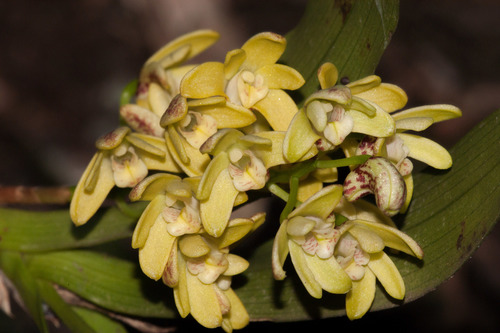
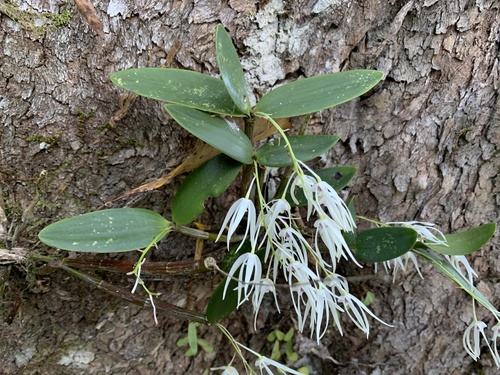
Dendrobium aemulum R.Br., commonly known as the ironbark feather orchid, is an epiphytic herb. It produces hard, straight, projecting pseudobulbs that are reddish or purplish brown, measuring 50–180 mm (2–7 in) long and 7–12 mm (0.3–0.5 in) wide. Each pseudobulb bears between two and four dark green, leathery leaves, that are 20–50 mm (0.8–2 in) long and 20–30 mm (0.8–1 in) wide, folded along their midline. Its flowering stems are 20–100 mm (0.8–4 in) long, and carry between two and twelve resupinate flowers that range in color from white to pale yellow. Each flower is 17–20 mm (0.67–0.79 in) long and 20–25 mm (0.79–0.98 in) wide. The dorsal sepal is 18–25 mm (0.7–1 in) long and 3 mm (0.1 in) wide. Lateral sepals curve downwards, and are 16–22 mm (0.6–0.9 in) long and about 3 mm (0.1 in) wide. Petals are a similar length to the dorsal sepal, but only about 1 mm (0.04 in) wide. All sepals and petals spread widely, droop, and often turn pink as the flower ages. The labellum is also white to pale yellow, 6–7 mm (0.2–0.3 in) long and 5–6 mm (0.20–0.24 in) wide, with purplish markings and three lobes. The side lobes are pointed and curve upwards, while the middle lobe curves downwards. Flowering occurs between August and October. The flowers are reputed to produce a sweet scent at night, which suggests they are pollinated by night-flying insects. This orchid grows on trees that do not shed their bark, including ironbarks, brush box (Lophostemon confertus), and cypress pine (Callitris species). It occurs in open forest from the coast to nearby tablelands, between the Calliope Range near Gladstone in Queensland and Moruya in New South Wales.