About Dendrobates tinctorius (Cuvier, 1797)
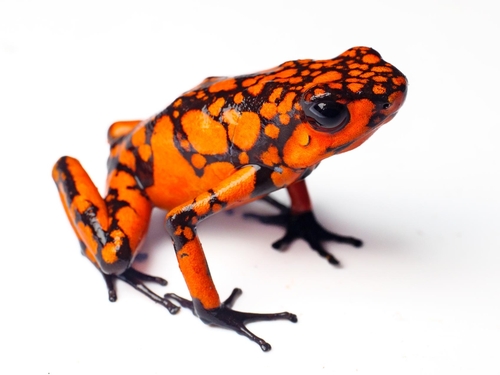
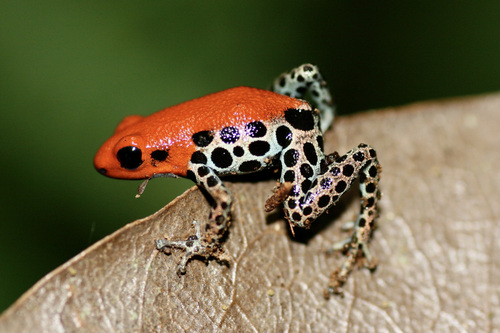
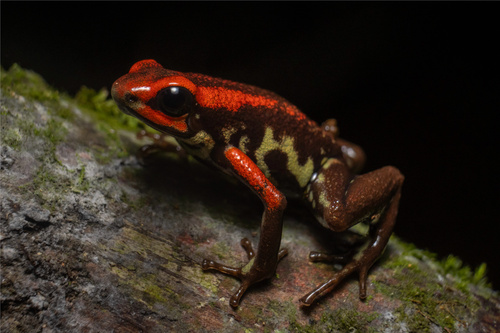
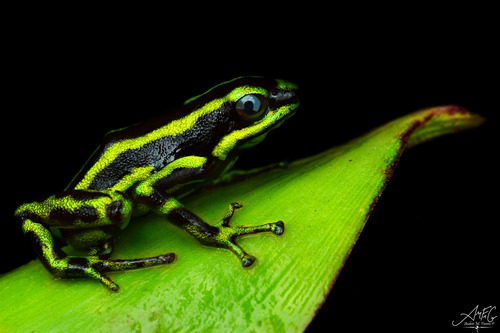
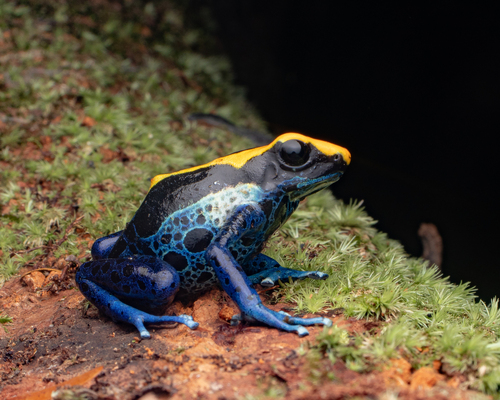
Dendrobates tinctorius, commonly called the dyeing poison dart frog, is large for a poison dart frog, though it may be smaller than Phyllobates terribilis and Ameerega trivittata. Small morphs of D. tinctorius reach 3.5 cm (1.4 in) in snout–vent length; most morphs are around 5 cm (2.0 in) long or slightly larger, and some of the largest morphs may reach 7 cm (2.8 in). While individual morphs differ in average size, size ranges overlap, meaning a large individual from a small morph is often comparable in size to a small individual from a large morph. Males are typically smaller and more slender than females, and have larger toe discs. Female toe discs are circular, while male toe discs are heart-shaped. Females also have arched backs, in contrast to males which have curved backs. The dyeing poison dart frog occurs in discrete patches across the eastern Guiana Shield, at altitudes up to 600 m (2,000 ft). It lives in tropical primary rainforests, and is most commonly associated with areas that have canopy gaps. It is mostly found in upland areas such as hills or at the base of mountains, though populations also exist at sea level. Erosion of highland habitats has led to the formation of isolated populations of this species. One study found that Dendrobates tinctorius tadpoles can survive in pools with high levels of KH, salinity up to 955 ppm, and vertical height of 15 miles (79,000 ft). Like most species in the genus Dendrobates, D. tinctorius is highly toxic if consumed. It produces pumiliotoxins and allopumiliotoxins that it uses for self-defense. Pumiliotoxins are weaker than their derivative allopumiliotoxins and the batrachotoxins secreted by Phyllobates species, but they are toxic enough to deter most animals from preying on the frog. If the frog is handled roughly, its toxins cause pain, cramping, and stiffness in humans. Because of this toxicity, predators that attempt to eat D. tinctorius typically learn to associate the frog’s bright coloration with the unpleasant taste and pain that follows ingestion. As a highly variable species, different color morphs of D. tinctorius have different levels of toxicity, and many can cause serious effects including death in humans. A report of envenomation by this species comes from the northwest of the Brazilian Amazon rainforest, involving two male photographers aged 30 and 47. The first photographer quickly captured the frog and held it with his bare hands for around five seconds, then released it and washed his hands in a nearby stream. The second photographer held the frog in place by placing both hands on top of it. Neither photographer received hand injuries from the interaction. Both then photographed the frog for around five minutes without touching it again. Twenty minutes after the initial contact, the first photographer began to feel numbness in his right arm, concentrated around the forearm. The second photographer, who touched his mouth with his unwashed hands after taking photos, felt slight numbness in his lower lip. After 40 minutes, both no longer experienced symptoms. Their symptoms could have become more severe if contact with the frog had lasted longer, or if there had been open wounds at the contact sites. The primary alkaloid carried by this species is pumiliotoxin (PTX), which is highly toxic. PTX interferes with muscle contraction by affecting calcium channels, causing locomotor difficulties, clonic convulsions, paralysis, or even death. D. tinctorius toxin can also lead to cardio-respiratory problems, primarily through its neurotoxic action that affects sodium and potassium channels. This impairs muscle contraction, and consequently affects function of the heart and breathing muscles.