About Dendrobates auratus (Girard, 1855)
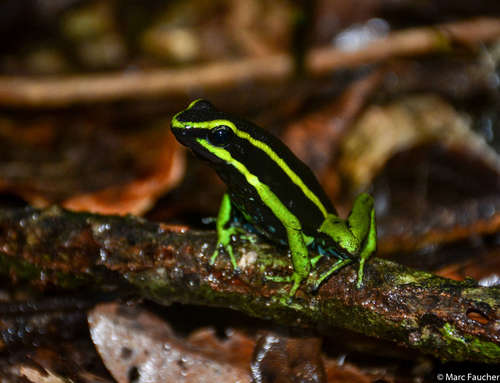
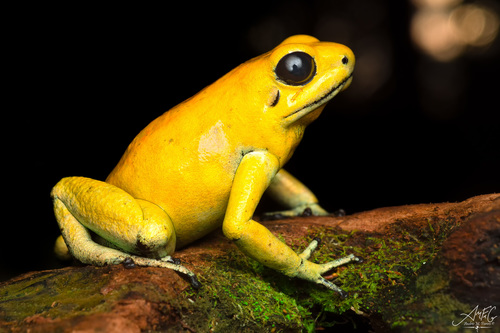
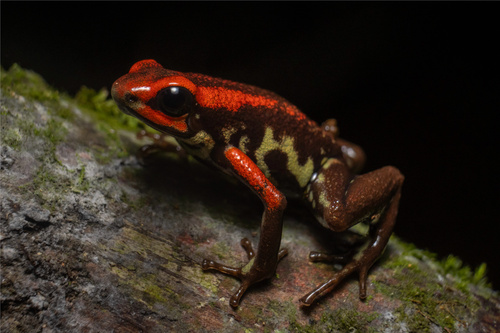
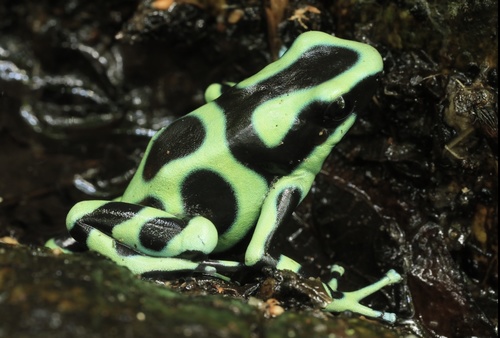
Dendrobates auratus, commonly known as the green-and-black poison dart frog, has the typical body appearance of other members of its poison dart frog family. Males average 0.75 inches (1.9 cm) in snout–vent length, while females are slightly larger, averaging 1 inch (2.5 cm) or longer. This species is one of the most variable of all poison frogs in terms of color and pattern. This variation occurs between individuals, and also depends heavily on the exact geographic location of the population. Despite its common name, some variants have no green or no black; a small number of variants, such as the brown and cream-white Campana variant, may have neither green nor black. Most often, green-and-black poison dart frogs have a highly variable spotted or banded pattern in vivid mint-green coloration, but the light color can also be darker green, forest-green, lime, emerald, turquoise, or even blue, whitish or pale yellow. This light coloration is mixed with splotches of dark or dull coloring, most often blackish, that range from whitish-brown and bronzy brown to dark brown and pure black. The amount of dark or dull coloring varies greatly; certain variants are entirely black, or dark with only a few small green spots or streaks, and the dark marking can appear as large or small spots or blotches, or as a dappled or "splashed" pattern. The green-and-black poison dart frog is found in humid lowland and submontane forests at altitudes of 0–1,000 m (0–3,280 ft). Its native range includes the Atlantic slope of southeastern Nicaragua, the Atlantic slope of eastern Costa Rica, the Pacific slope of southwestern Costa Rica, most of Panama, and far northwestern Colombia’s Chocó Department. An introduced population exists on Oahu, Hawaii, where the species was intentionally introduced in 1932 for mosquito control. It has also since become established on Maui. Unlike other poison dart frogs, green-and-black poison dart frogs gather in large groups before mating. Individuals compete for territories, and eventually each male clears a small patch for himself. Females move between the males, and males attempt to attract females with their bird-like mating calls. Captive females are known to fight each other when calling males are present. Once a male has attracted a female, he leads her to an egg deposition site he selected. The female lays her eggs, which the male then fertilizes. The eggs hatch into tadpoles after approximately 14 days. A parent, typically the male, carries the tadpoles up into the canopy; the tadpoles stick to the mucus covering the parent’s back. The parent then deposits the tadpoles into small pools of water that collect in the center of bromeliads, and guards the tadpoles as they feed on algae and small invertebrates living in the tiny pool. While it is not the most toxic poison dart frog species, the green-and-black poison dart frog is still a highly toxic animal. A very small amount of the poison it carries is enough to stop a human heart. Like all poison dart frogs, the green-and-black poison dart frog loses its toxicity when kept in captivity, due to a change in diet. This observation has led some scientists to believe that this species actually obtains its poison from the mites, springtails, ants, and other insects such as beetles and flies that it eats in the wild.