About Dendroaspis angusticeps (Smith, 1849)
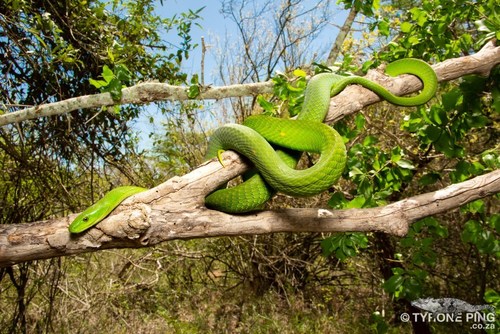
Dendroaspis angusticeps, commonly known as the eastern green mamba, is a large snake with a very slender, slightly compressed body and a medium to long tapering tail. Adult males average around 1.8 metres (5 ft 11 in) in total length, while adult females average 2.0 metres (6 ft 7 in). This species rarely reaches lengths over 2.5 metres (8 ft 2 in). In general, total body length is 4–4.3 times the length of the tail. Adult eastern green mambas have bright green upperparts, occasionally with isolated yellow scales, and a pale yellow-green belly. Individuals may be duller in colour before moulting. Juveniles are blue-green, and develop their bright green adult colouration when they reach around 75 centimetres (2 ft 6 in) long. The species has a long, slender, coffin-shaped head with a prominent canthus that is slightly set apart from the neck. When threatened or aroused, the eastern green mamba can flatten its neck area into a slight hood. It has medium-sized eyes with round pupils; the pupil borders have a narrow golden or ochre edge, and the irises are olive green, turning bright green toward the back of the eye. The inside of the mouth may be white or bluish-white. In Southern Africa, other green snakes are often called "green mambas", including green colour morphs of the venomous boomslang (Dispholidus typus), which can be distinguished by their larger eyes and shorter heads. Smaller green bush snakes of the genus Philothamnus are also commonly confused with smaller eastern green mambas. The eastern green mamba is native to coastal regions of Southern Africa and East Africa. Its range extends south from Kenya through Tanzania, Malawi, eastern Zimbabwe and parts of Zambia, and it is also found in Zanzibar and northern Mozambique. An isolated, genetically distinct population occurs in South Africa, from the extreme northeastern part of Eastern Cape along the KwaZulu-Natal coastline into southern Mozambique. This is an elusive species that is primarily arboreal, meaning it lives in trees, and is usually well camouflaged in foliage. Some herpetologists believe its habitat is limited to tropical rainforests in coastal lowlands, while other experts note it can also be found in coastal bush, dune forest and montane forest. Unlike its close relative the black mamba, the eastern green mamba is rarely found in open terrain, and prefers relatively dense, well-shaded vegetation. In addition to wild forest habitats, it is also commonly found in thickets and farm trees including citrus, mango, coconut, and cashew. In coastal East Africa, it is known to enter houses and may even shelter in thatched-roof dwellings. Specimens have been recorded at elevations up to 1,500 metres (4,900 ft) above sea level. The eastern green mamba is a diurnal species, active during the day and sleeping at night coiled in foliage, or more rarely in a hollow within a trunk or branch. It is an agile snake and a skilled climber, and is not often found on the ground, though it may come down to bask in morning sunlight for thermoregulation. A 27-day study of the movement patterns of two adults found their activity area was relatively small, similar to ambush predators rather than active foraging predators. This differs from most elapid species, including other mambas, which tend to hunt and forage actively. Preliminary evidence from the study suggests the eastern green mamba is primarily an ambush predator due to its sit-and-wait behaviour, though this does not rule out active foraging: one specimen was observed systematically hunting a sleeping bat. There is no evidence that the eastern green mamba migrates. It is thought to be relatively sedentary, and can remain in the same location for days, moving most often only to find food or mates. On average, individual eastern green mambas move only about 5.4 metres (18 ft) per day. They generally avoid contact with people and other predators, and only attack if they feel threatened. The eastern green mamba is solitary except during the breeding season. Gravid females tend to be sedentary, but males actively seek out and court prospective mates during the rainy season between April and June. Males have been observed engaging in agonistic behaviour, and may fight each other for mating opportunities or to establish a dominance hierarchy. Typically, one male initiates a fight by moving on top of the other male's body and tongue-flicking, after which the two entwine, push each other, and attempt to pin the other's head to the ground. Male combat can last for several hours, but is less aggressive than combat commonly seen in black mambas, and combatants do not bite each other. Males locate females by following a scent trail. The male courts the female by aligning his body along the female's while flicking his tongue rapidly. If the female is receptive to mating, she lifts her tail, and cloacal juxtaposition follows. Courtship and mating take place in trees. After mating, females lay 4–17 eggs (10–15 on average) in October and November. The eggs are small and elongated, usually measuring 47–58 x 25–28 mm, and are typically laid in leaf litter inside hollow trees. The incubation period is around three months. When young eastern green mambas hatch, they measure approximately 30 to 45 cm (12 to 18 in) long in the wild, and 44 cm (17 in) in captivity. They usually develop their adult colouration when they reach 75 cm (30 in) long. Hatchlings generally grow to 50 to 80 cm (20 to 31 in) in their first year. As they age, their growth rate decreases but never stops entirely. The oldest recorded eastern green mamba was a captive specimen that lived 18.8 years; another captive specimen lived 14 years.