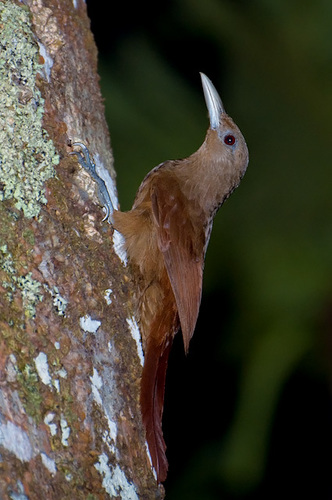
About Dendrexetastes rufigula (Lesson, 1844)
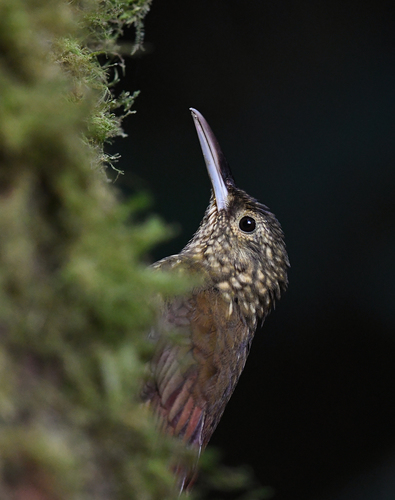
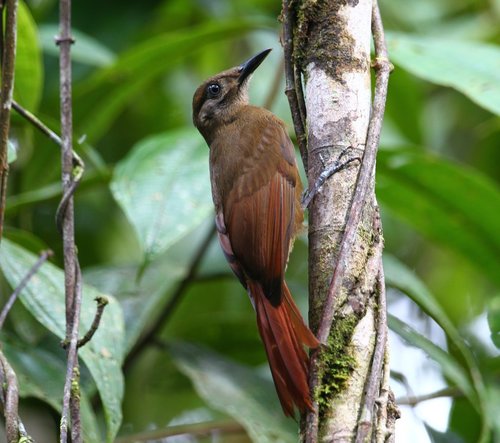
The cinnamon-throated woodcreeper (Dendrexetastes rufigula, first described by Lesson in 1844) is one of the larger woodcreeper species, with a heavy body, short wings, and a short, stout bill that ends in a slightly hooked tip. It measures 22.5 to 27 cm (8.9 to 11 in) in length. Males weigh 64 to 74 g (2.3 to 2.6 oz), while females weigh 66 to 77 g (2.3 to 2.7 oz), and the two sexes have identical plumage. The nominate subspecies D. r. rufigula has mostly medium brown upperparts, with a paler crown and rufous-chestnut wings, rump, and tail. A small number of whitish streaks run across the nape and upper back. Underparts are generally paler and more cinnamon-brown than upperparts. The throat is a brightish rusty buff, the breast has wide black-edged whitish streaks that extend to the sides of the neck, and there are sometimes weak darker bars on the lower belly and undertail coverts. Its iris ranges from red to light brown, its bill is horn-gray, bluish horn, brownish, or dull greenish yellow, and its legs and feet are slate gray, greenish gray, bluish black, or brown. Subspecies D. r. devillei has a weaker patterning than the nominate, with much fainter streaks on the breast, no streaks on the neck, and no bars on the belly. D. r. paraensis is very similar to the nominate, but it has a bold white supercilium and rounder streaks on the breast and neck. D. r. moniliger is duller and less rufescent than the other subspecies, but has bolder streaking on the breast and neck. The four subspecies have distinct ranges across the Amazon basin: D. r. devillei is found in western Amazonia, from central Colombia, eastern Ecuador, and eastern Peru east into Brazil as far as the Rio Madeira (and probably to the Rio Negro), and south into northern Bolivia; D. r. rufigula is found in northeastern Amazonia from eastern Venezuela through the Guianas, and in northern Brazil from the Rio Negro to the Atlantic Ocean; D. r. moniliger occurs in Amazonian Brazil south of the Amazon River between the Rio Madeira and the Rio Tocantins, and south to Mato Grosso; D. r. paraensis is found in Amazonian Brazil south of the Amazon and east of the Rio Tocantins. The cinnamon-throated woodcreeper mostly lives in humid forest, including both terra firme and várzea types. In the Guianas, it typically occurs in forest on sand ridges and savanna. It prefers palm forest, evergreen forest edges, and mid- to late-age secondary forest over the interior of primary forest, and it is also frequently found on river islands. Most individuals occur below 500 m (1,600 ft) in elevation, but it is occasionally found as high as 950 m (3,100 ft) in the Andean foothills at the western edge of its range.